Israel’s Lebanon Strikes Threaten to Unravel the US-Iran Ceasefire
Quick Reads
- The United States and Iran agreed to a two-week ceasefire on April 8, brokered by Pakistan, halting more than five weeks of war between the two countries.
- Within hours of the announcement, Israel launched what it called its biggest wave of strikes on Lebanon since the war began, killing over 250 people and wounding more than 1,160.
- Israel and the United States insist Lebanon is not covered by the ceasefire, contradicting Pakistan’s mediator, Prime Minister Shehbaz Sharif, who said the pause applied “everywhere, including Lebanon.”
- Iran accused the US of violating the deal and threatened to close the Strait of Hormuz and withdraw from peace talks set to begin in Islamabad on Saturday.
- World leaders including the heads of France, the UK, Germany, Spain, and the UN Secretary-General have condemned the Lebanon strikes and called for their inclusion in the ceasefire.
A fragile two-week ceasefire between the United States and Iran came under immediate threat on Wednesday, April 8, as Israel launched its largest coordinated military offensive in Lebanon since the war began, killing more than 250 civilians within hours of the truce being announced.
The ceasefire, brokered by Pakistani Prime Minister Shehbaz Sharif, was reached barely an hour before US President Donald Trump’s self-imposed deadline for Iran to reopen the Strait of Hormuz or face strikes on its power plants and infrastructure. Trump announced the deal as “a big day for World Peace” and said it would allow two weeks for a permanent settlement to be negotiated. Talks are scheduled to begin in Islamabad on Saturday, led by US Vice President JD Vance.
The dispute at the center of everything
Sharif, whose government served as the central intermediary in the negotiations, announced the ceasefire with a clear geographic scope. “The Islamic Republic of Iran and the United States of America, along with their allies, have agreed to an immediate ceasefire everywhere, including Lebanon and elsewhere, EFFECTIVE IMMEDIATELY,” he wrote on X.
Israel rejected that framing the same night. Prime Minister Benjamin Netanyahu’s office issued a statement confirming that Israel supported Trump’s decision to pause strikes against Iran, but added explicitly that the ceasefire “does not include Lebanon.” Netanyahu later told a press conference that Israeli operations against Hezbollah would continue. The United States backed that position. Trump told PBS News that Lebanon was excluded from the deal “because of Hezbollah,” while Vice President Vance said Iran would be “dumb” to let the negotiations collapse over what he called a “separate” conflict.
Iran disagreed sharply. Foreign Minister Abbas Araghchi cited Sharif’s announcement and said Washington had to choose between a genuine ceasefire and continued Israeli attacks on Lebanon. “It cannot have both,” Araghchi wrote on X. Iran’s Parliament Speaker Mohammad Bagher Ghalibaf warned that time was running out and declared Lebanon “an inseparable part of the ceasefire.” Tehran also threatened to suspend tanker traffic through the Strait of Hormuz in response to Israel’s continued assault.
The scale of the destruction
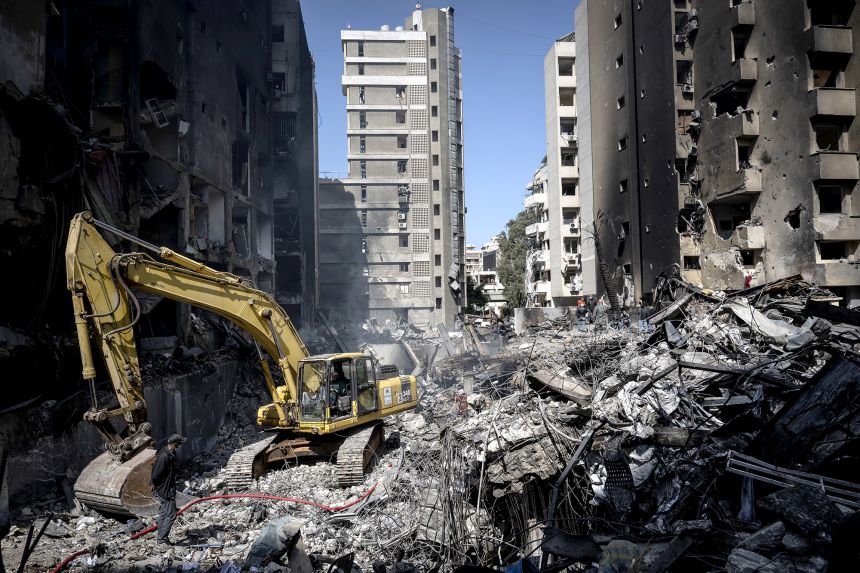
Lebanon’s civil defence reported at least 254 people killed and more than 1,165 wounded on Wednesday alone in strikes across Beirut, the Bekaa Valley, and the south of the country, including densely populated residential areas. The Israeli military said it targeted more than 100 Hezbollah command centres and military infrastructure sites in the single largest coordinated wave of strikes Lebanon had seen since the war began, deploying 50 Air Force jets and approximately 160 munitions.
Lebanese Parliament Speaker Nabih Berri described the attacks on civilian neighbourhoods as “a full-fledged war crime.” Lebanese Prime Minister Nawaf Salam called the strikes “a new massacre.” The head of Lebanon’s doctors’ syndicate, Elias Chlela, issued an urgent public call for all physicians of any speciality to report to the nearest hospital immediately. More than 1.2 million people have been displaced inside Lebanon since the Israeli invasion began. The country declared a national day of mourning on Thursday.
UN Secretary-General Antonio Guterres warned that Israel’s continued military activity in Lebanon “poses a grave risk” to the ceasefire and called on all parties to immediately cease hostilities. The leaders of France, Germany, the United Kingdom, Spain, Italy, the Netherlands, Denmark, Canada, and the heads of the European Commission and European Council issued a joint statement calling for Lebanon’s inclusion in the truce.
Why Lebanon matters to Iran, and to the deal
Hezbollah, the Iran-backed armed group based in Lebanon, is Tehran’s most significant regional ally and the cornerstone of what Iran describes as its “axis of resistance”, a network of armed groups across the Middle East. Analysts warn that allowing Israel to degrade Hezbollah while a ceasefire with Iran is in effect could strip Tehran of its leverage and signal that it has quietly accepted one of Washington’s core demands: that Iran sever ties with its regional proxies.
King’s College London professor Andreas Krieg told Al Jazeera that Lebanon is the “Achilles’ heel” of the ceasefire and could force Iran to retaliate against Israel to maintain its credibility as a security partner for Hezbollah.
On Thursday, a development emerged that pointed toward a possible off-ramp. Netanyahu announced Israel would begin direct negotiations with Lebanon’s government over disarming Hezbollah and normalising relations, though he maintained there was no ceasefire in place. Lebanon’s government responded by saying it would not enter negotiations while its territory was still under fire and that it had not been officially notified of any invitation to talks.
Vance confirmed that Israel had privately offered to scale back its Lebanon operations to avoid undermining the US-Iran negotiations, a signal, he said, that came from Israel itself, not from any ceasefire obligation.