Burkina Faso’s Junta Leader Tells Citizens to Forget Democracy
Quick Reads.
- Burkina Faso’s military leader Captain Ibrahim Traoré told journalists on Thursday that his country must “forget” democracy, calling the system destructive and unsuitable for Africa.
- Traoré made the remarks in a wide-ranging interview aired on national state television, citing Libya as proof that externally imposed democratic transitions lead to violence.
- The statements come three months after his government dissolved all political parties and seized their assets in January 2026.
- Traoré originally pledged to restore civilian rule by July 2024 but extended junta control by five years just before that deadline and shut down the national electoral commission in July 2025.
- A Human Rights Watch report published the same day found that more than 1,800 civilians have been killed in Burkina Faso since Traoré seized power in 2023, with two-thirds of those deaths attributed to government forces and allied militias.
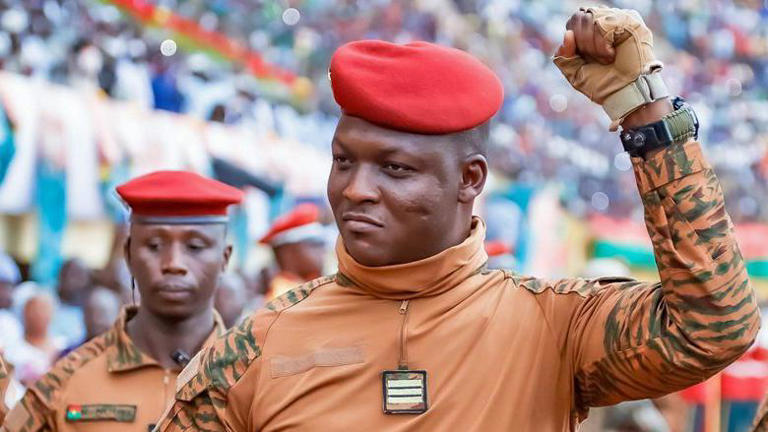
Burkina Faso’s military ruler Captain Ibrahim Traoré publicly rejected democratic governance on Thursday, telling citizens the country must abandon it entirely. Speaking during a roundtable interview broadcast on state television on the night of April 3, 2026, the 38-year-old junta leader said democracy “kills” and is “not for us”, the clearest signal yet that he has no intention of returning power to civilian hands.
“People need to forget about the issue of democracy,” Traoré said, according to Reuters. “We have to tell the truth: democracy isn’t for us.” He pointed to Libya as a cautionary example, arguing that outside powers have repeatedly attempted to install democracy across the world only to leave behind bloodshed. French broadcaster RFI reported him saying: “Democracy is slavery.”
Traoré did not outline a concrete alternative system of governance. He said his government was pursuing its own distinct approach rooted in national sovereignty, with traditional authorities and community organisations playing a central role. He also called for economic and military self-reliance, saying working six- or eight-hour days would not allow Burkina Faso to catch up with wealthier nations.
The comments are the latest move in a systematic dismantling of political institutions since Traoré seized power in September 2022. Parliament and all political activity were suspended after the coup. In July 2025, the Independent National Electoral Commission was dissolved, with the junta citing cost. In January 2026, more than 100 registered political parties were banned and their assets seized as part of what the government described as a plan to “rebuild the state.” Critics, journalists, and prosecutors who pushed back have faced forced conscription to the front lines of the country’s ongoing conflict with Islamist militants.
The security situation Traoré used to justify delaying elections has not improved under his leadership. According to analysis by the Africa Center for Strategic Studies cited by Al Jazeera, fatalities tripled in the three years since Traoré took power, reaching 17,775 by May 2025, compared to 6,630 combined recorded deaths in the three years before he came to power. A Human Rights Watch report published Thursday attributed the majority of civilian killings to government forces and allied militias rather than to Islamist groups. The government did not respond to Reuters’ request for comment on that report.
Burkina Faso’s direction mirrors that of its neighbours Mali and Niger, both run by military rulers who took power in coups, dissolved political parties, and replaced French forces with Russian military support. All three nations exited the Economic Community of West African States in January 2025 to form the Alliance of Sahel States after sustained pressure to hold elections. Despite worsening conditions on the ground, Traoré retains a significant following across parts of the continent for his pan-Africanist stance and outspoken rejection of Western influence.