Cloud vs Edge AI: The Future Battle Reshaping How Businesses Deploy Intelligence
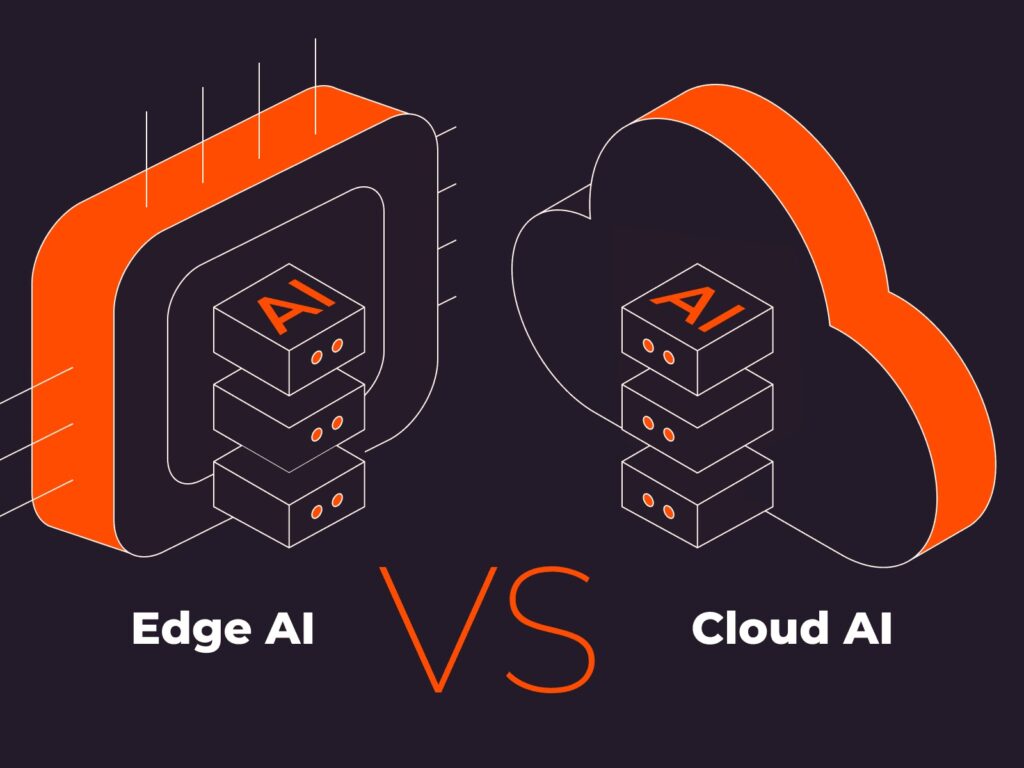
The race is no longer just about building smarter AI. Now, it is about where that intelligence lives. The Cloud vs Edge AI debate has moved from tech boardrooms into factories, hospitals, and autonomous vehicles. The stakes have never been higher.
Cloud AI lives in centralized servers inside massive data centers. It processes huge amounts of data and delivers powerful insights. However, it relies on constant internet connectivity and can introduce latency. Edge AI, by contrast, brings intelligence closer to the devices themselves, a smartphone, a smart camera, a factory robot. It processes data locally for real-time insights and enhanced privacy.
Both approaches are maturing fast. Still, the question driving enterprise decisions in 2026 is simple: which one fits your needs?
The cloud has become too slow for modern real-time demands. Waiting for data to travel to a distant data center is no longer acceptable. A self-driving car cannot afford that delay. That urgency is pushing Edge AI firmly into the spotlight.
In 2025, the AI story was about scale, GPUs, massive data centers, and record capital expenditure. In 2026, the story is shifting. Now, it is about networks that make edge-to-cloud systems fast, reliable, and secure enough for real-time decisions.
Yet Cloud AI is far from retreating. Most AI models are still trained in the cloud. Nevertheless, execution increasingly happens at the edge through hybrid architectures. These balance speed with security and control. Hyperscalers like AWS, Microsoft Azure, and Google Cloud are not sitting still either. Their competition in 2026 is no longer about the biggest data center footprint. Instead, it is about powering AI at scale with better performance, cost efficiency, and regulatory alignment.
The cost argument is shifting too. For high-volume, low-latency workloads, Edge AI can be 30–50% cheaper over a five-year horizon. Cloud AI, on the other hand, remains attractive for sporadic, compute-heavy tasks where scaling costs stay low.
Privacy is another flashpoint in the Cloud vs Edge AI battle. Edge AI processes data locally. Raw sensor readings never leave the device. For industries handling health data, financial transactions, or proprietary manufacturing processes, this dramatically reduces breach risks. Meanwhile, cloud centralization introduces a single point of failure. One breach in a cloud data center can expose millions of records.
Regulators are paying close attention. The EU’s AI Act, effective in 2025, mandates rigorous audits for high-risk AI systems. Edge AI satisfies these audits more readily by limiting data movement. Cloud AI, therefore, must demonstrate robust data governance frameworks to stay compliant.
On the hardware front, Edge AI is getting a major boost. Every major chipmaker is doubling down on AI accelerators. Devices now ship with NPUs or dedicated AI cores. These run models fast with minimal power. As a result, real-time inference happens right where the data lives. Moreover, small language models built for edge deployment are gaining traction. They deliver 80–90% of large model capabilities while running entirely on-device.
Industries are already choosing sides, or rather, choosing both. The organisations running AI effectively in 2026 are not picking one approach. Instead, they are running hybrid architectures. Latency-sensitive and privacy-sensitive tasks go to the edge. Model training, large-scale analytics, and batch processing, however, stay in the cloud.
Dell CTO John Roese has reinforced this point. He states that running models locally, on premises or in controlled AI factories, will become the norm. This provides a stable foundation and shields organisations from external disruptions.
Real-world data backs this up. A ZEDEDA survey shows that 97% of CIOs have deployed or plan to deploy Edge AI. Additionally, 60% are already leveraging multimodal AI. In retail, 78% of stores plan hybrid setups by 2026.
Furthermore, manufacturing CTOs report that edge-based predictive maintenance cuts unplanned downtime by up to 40%. Healthcare systems, similarly, now run diagnostic AI directly on medical devices. This eliminates compliance concerns and accelerates clinical workflows.
So, who wins the Cloud vs Edge AI battle? The answer, ultimately, is neither, and both. It is not about replacing one with the other. Rather, it is about using each where it performs best. Hybrid AI will be the clear winner. It combines real-time, on-device intelligence with the cloud’s power for training massive models and syncing data across millions of devices.
In 2026, the choice between cloud and edge depends entirely on business goals, compliance needs, and speed expectations. Together, they form a powerful foundation for AI-driven, automation-ready enterprises.
The real battle, it turns out, is not Cloud vs Edge AI at all. It is about who builds the smartest hybrid strategy first.
Writer: Princely Oriomojor