SRE Agent Reduce Downtime: How AI Transforms Incident Response
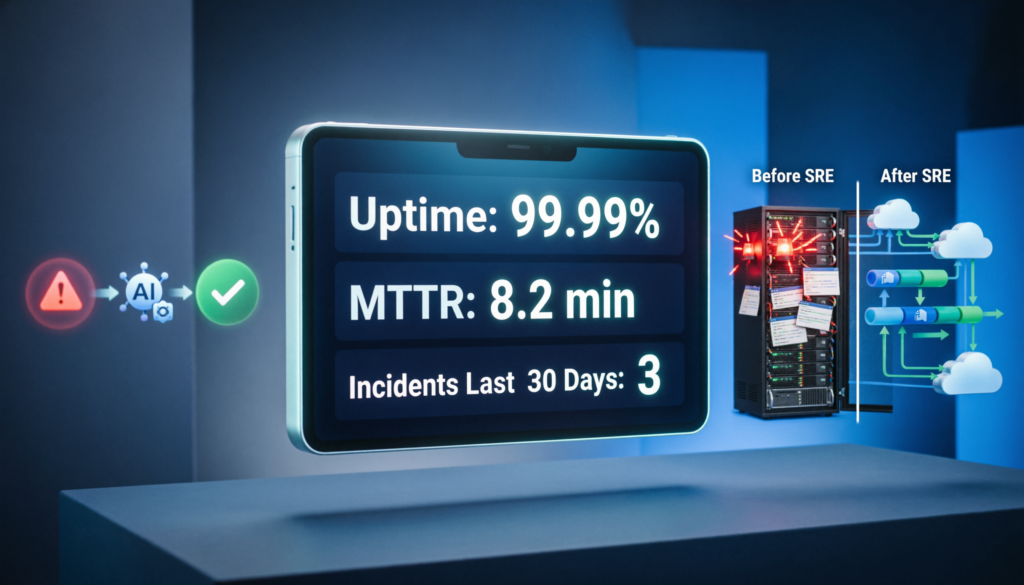
An SRE agent can reduce downtime before it costs your business. At 2 a.m., when an alert fires and a potential failure unfolds, most engineering teams respond frantically, manually, and exhaustingly.
A newly published guide, explains how an AI-powered SRE agent helps teams reduce downtime by automating the most time-consuming parts of incident response. Rather than replacing engineers, the SRE agent amplifies them. It handles repetitive triage so engineers can focus on what actually matters.
Unlike traditional automation scripts that blindly follow fixed instructions, an SRE agent observes, learns, and adapts. It monitors telemetry continuously, connects to service catalogs and dependency maps, and uses AI to correlate alerts, logs, and recent changes. The result is faster mean time to resolution (MTTR) and less on-call burnout.
The practical approach to getting started covers four key areas.
First, teams should offload initial alert triage to the agent. Instead of one on-call engineer drowning in repeated notifications, the SRE agent captures all alerts simultaneously. It groups related signals, suppresses noise, and enriches each incident with context. That alone transforms the early response experience.
Next, the SRE agent accelerates diagnosis. Rather than a generic alert, it delivers a summary of the likely root cause, affected services, and relevant log data. Engineering teams that once had to manually interrogate data during an outage can now reach the root cause much faster. This is precisely how AI agents are redefining the SRE role.
Once the cause is clear, the agent shifts from diagnosis to resolution. Teams can choose between two modes. In review mode, the agent recommends a specific action, restarting a pod or executing a failover runbook, and waits for human approval. In autonomous mode, for well-understood and lower-risk issues, the agent acts independently. However, PagerDuty strongly recommends starting with review mode. Granting too much autonomy too quickly is the primary risk with agentic AI. Building trust gradually is, therefore one of the most important incident response best practices for reducing MTTR.
After resolution, the SRE agent does not go idle. Instead, it retains a full memory of the incident, what happened, what was tested, and what worked. Consequently, this knowledge feeds into automated postmortem generation, improves runbooks, and prevents recurrence. As PagerDuty documents in a related post, an SRE agent with memory is already transforming incident response across engineering teams.
The business case is equally clear. Faster incident resolution protects revenue. Research cited by PagerDuty confirms that even brief outages carry measurable financial and reputational costs. Furthermore, freeing engineers from repetitive toil redirects talent toward innovation rather than firefighting. Over time, the SRE agent builds a virtuous cycle of system improvement across the organisation.
PagerDuty’s SRE agent is part of the industry’s first end-to-end AI Agent Suite, delivered through the PagerDuty Operations Cloud. For teams ready to move from reactive firefighting to proactive resilience, the PagerDuty SRE Agent is built to get them there.