The US Says China Is Losing the AI Race. Not Everyone Agrees.
The China AI gap just got official, at least according to Washington. A new report from the Center for AI Standards and Innovation (CAISI), a division of the National Institute of Standards and Technology (NIST), claims that China’s most advanced AI model is roughly eight months behind leading American systems. The model in question is Deepseek V4 Pro, which CAISI calls the most capable Chinese AI model to date and still not good enough to keep pace.
CAISI tested Deepseek V4 Pro across five domains: cybersecurity, software development, math, natural sciences, and abstract reasoning. While Deepseek’s own technical report positions the model as comparable to current US leaders like Claude Opus 4.6 and GPT-5.4, CAISI’s private testing tells a different story. According to the agency, Deepseek V4 Pro actually performs closer to the older GPT-5, which launched eight months ago. The China AI gap is most visible in abstract reasoning, cybersecurity, and software development. Math is the one category where Deepseek V4 comes close to matching the top US models.
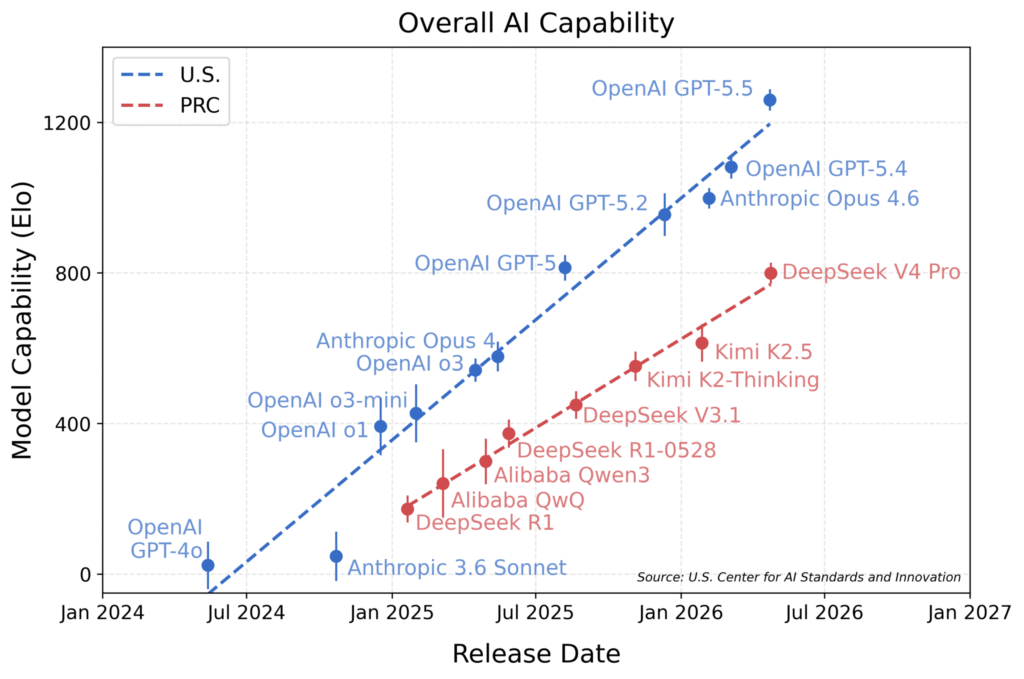
Still, the CAISI report doesn’t exist in a vacuum. The agency operates with its own political interests, and independent benchmarking from Artificial Analysis paints a more measured picture one where the gap between US and Chinese models has remained fairly constant over time, not widened dramatically as CAISI suggests.
Where China does pull ahead is on price. Deepseek V4 undercut the comparable GPT-5.4 mini in five out of seven cost tests. That matters more now than it might have a year ago, as AI models are increasingly expected to handle longer, more complex tasks while top US models continue to get more expensive. The business case for “good enough” AI at a lower price point is becoming harder to dismiss, especially when measuring AI’s actual productivity gains remains elusive.
It is worth noting that Cursor, the coding tool reportedly being acquired by SpaceX, built its latest model on a Chinese open-weight base a decision driven largely by cost. OpenAI CEO Sam Altman has acknowledged the tension. In a recent post on X, he noted that he often finds himself wanting models to be faster and cheaper more than smarter but still believes raw capability is what matters most.
The China AI gap debate ultimately hinges on what you measure and who is doing the measuring. Raw benchmark scores favour the US. Price efficiency still favours China. And with AI development accelerating on both sides, today’s gap, however wide or narrow may look very different in another eight months.