Apple Wanted to Ship the New Mac Studio by Summer.
Quick Reads
- Bloomberg’s Mark Gurman reports the next Mac Studio, expected around mid-2026, has been pushed to October due to a global memory chip shortage
- The long-awaited touchscreen MacBook Pro, previously expected in late 2026, is now likely slipping to early 2027 for the same reason
- AI data centres are absorbing enormous quantities of RAM and storage components worldwide
- The current Mac Studio is already running low on stock, with several configurations completely unavailable, meaning buyers face a gap with no clear end date
If you have been waiting to buy a new Mac Studio, you will need a little more patience. According to Mark Gurman, writing in his Power On newsletter on April 19, 2026, the next generation of Apple’s compact pro desktop has been pushed from its originally planned mid-year release to sometime around October. The culprit is not a design problem, a software delay, or anything Apple did wrong. It is RAM. Or rather, the growing lack of it.
It was reported that a severe global memory shortage, driven largely by hyperscale AI infrastructure buildout, is now touching Apple’s hardware calendar in ways that were not expected even a few months ago. AI data centres require enormous volumes of the same high-bandwidth memory components that go into professional Macs. When that demand spikes, supply tightens across the board, and companies like Apple, even with their considerable purchasing power, start feeling it.
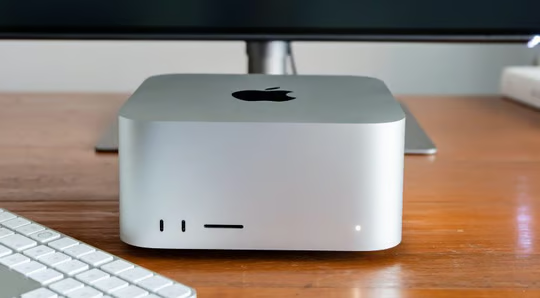
The current Mac Studio already tells that story. The machine, still running on a mismatched combination of M4 Max and M3 Ultra chips, has been showing long shipping delays and out-of-stock notices across Apple’s online store for weeks. What looked at first like a sign that a new model was coming soon turned out to be a symptom of something broader. MacRumors confirmed that Gurman’s sources within Apple now place the Mac Studio 2026 delay firmly in October territory, roughly four months later than the WWDC June window that had been the most widely expected launch point.
The refresh itself, when it does arrive, is expected to be a meaningful one. Macworld’s deep dive on the Mac Studio points to M5 Max and M5 Ultra chips, with the M5 Max already shipping inside the latest MacBook Pro lineup. The M5 Ultra, which Apple builds by fusing two M5 Max dies together, would bring roughly 36 CPU cores and up to 80 GPU cores. Thunderbolt 5, Wi-Fi 7, and enhanced neural accelerators for AI workloads are also expected. The design will stay the same, a chip-focused update rather than an external redesign. A Studio Display 2 with 120Hz ProMotion and HDR support has also been rumoured to launch alongside it.
The memory crunch is not just hitting the Mac Studio. Macworld reports that Apple’s first-ever touchscreen MacBook Pro, one of the most anticipated product redesigns in recent Mac history, is also feeling the squeeze. Gurman, who had previously placed that machine in a late 2026 to early 2027 window, now says buyers should prepare for the later end of that range. Early 2027 is increasingly likely. The touchscreen MacBook Pro is expected to arrive with an OLED display, Dynamic Island, a thinner chassis, and either M6 Pro and M6 Max chips or possibly the MacBook Ultra branding that has been circulating in rumour circles. Software preparations are reportedly on track, with macOS 27 being tuned for touch input, but that does not matter much if there are no components to build the machine.
Gizmodo noted that the MacBook Neo, Apple’s new entry-level notebook at around $599, has so far avoided the worst of the crunch, with strong sales but manageable supply. The problems appear concentrated at the high end, where Mac Studio configurations can ship with up to 256GB of RAM and 16TB of storage. Those are the exact specifications that make the shortage most painful. The more memory a product needs, the harder it is to source right now.
Apple put it plainly: Mac Studio buyers are not casual shoppers. Many purchase around production deadlines, studio buildouts, or annual equipment cycles. A four-month delay is not an inconvenience for those buyers. It is a real disruption. The choice now is whether to buy the existing model, accepting whatever stock remains, or wait until autumn for a meaningfully better machine that may itself face limited availability when it lands.
The larger irony here is hard to miss. AI is both the reason the Mac Studio exists as a product and the reason it cannot ship on time.