OpenAI Is Handing Students $10,000 Each
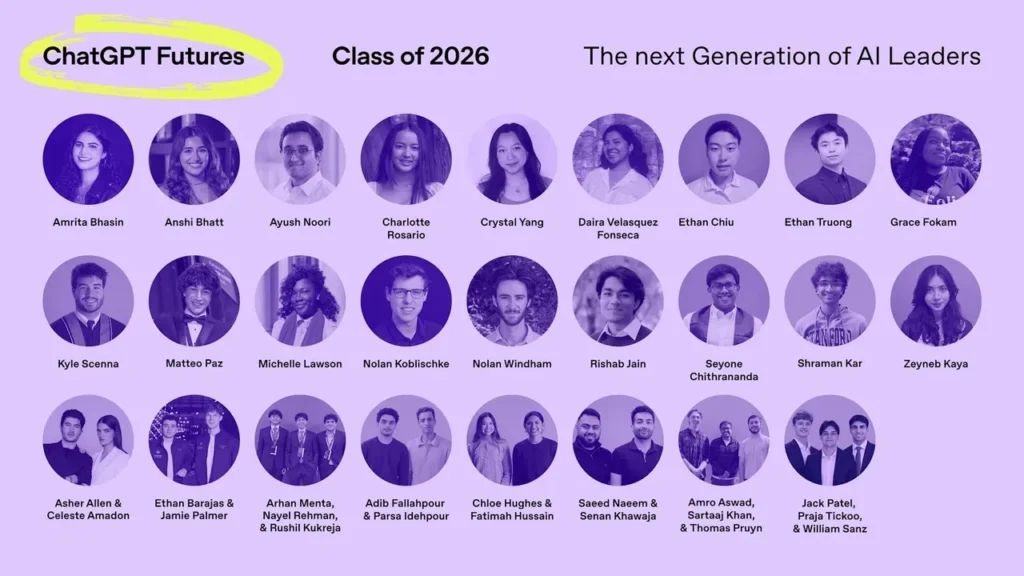
OpenAI has awarded 26 young innovators $10,000 each through a new program called ChatGPT Futures, recognising students and recent graduates who are using artificial intelligence to tackle real-world challenges in bold and creative ways. The OpenAI student AI innovation awards spotlight a generation that grew up alongside ChatGPT and is now using it to build things that were once considered out of reach for individuals without large teams or resources.
The timing is significant. The graduating class of 2026 is the first cohort of university students to have had access to ChatGPT throughout nearly their entire college experience, since the tool launched publicly in fall 2022.
Among the honourees is University of Pennsylvania student Crystal Yang, who founded a nonprofit called Audemy after being inspired by a blind friend who could not join in playing the popular game Wordle.
Yang has since developed more than 50 audio-powered games accessible to blind and visually impaired players, and is now prototyping an accessible gaming console with audio and tactile features that works without Wi-Fi. AI has played a role across her work, from coding and management to user research, game development, and evaluating hardware components.
Another honouree, Ayush Noori, a Harvard graduate and current Rhodes Scholar at the University of Oxford, developed a graph AI model called Proton that generates hypotheses around neurological disease. Motivated by his experience caring for his late grandmother who had a rare neurodegenerative condition, Proton has already shown early promise in suggesting candidate drugs for bipolar disorder and Alzheimer’s disease, with results validated through experiments on lab-grown brain tissue and analysis of health records.
Other recipients of the OpenAI student AI innovation awards are working on projects ranging from space robots that take over routine astronaut tasks, to Wi-Fi technology that detects survivors through walls after disasters, to tools that help elderly people avoid online scams and platforms that support Latin American street vendors with financial tracking.
Leah Belsky, head of education at OpenAI, said the program reflects what she has observed firsthand: students using AI to pursue ambitious initiatives and gain access to opportunities previously limited to those in well-resourced environments. “AI is giving them confidence,” she said. “It’s giving them agency, and it’s giving them a sense that they can actually learn and do things that they didn’t previously think were possible.”
The awards do not come without broader context. Critics have raised concerns that overreliance on AI can hinder rather than support learning, with students bypassing the difficult, iterative processes essential to developing real skills. Educators at both the secondary and university levels have also flagged issues around AI-assisted academic dishonesty.
Still, OpenAI says its goal is to work with the full education ecosystem to create environments where more students can develop this kind of driven, independent approach to using technology. The honourees are set to visit OpenAI’s offices in June, where they will meet staff, present their projects, and collect their awards.
OpenAI has placed no restrictions on how the prize money is spent, but Belsky expressed hope that winners use it to both advance their own projects and inspire others to do the same.