How Multi-Agent AI Systems Are Quietly Taking Over Business Workflows in 2026
Multi-agent AI systems have arrived. They are already running mission-critical operations inside the world’s biggest companies. This is not a future trend. It is happening right now, in 2026, at a scale few predicted just two years ago.
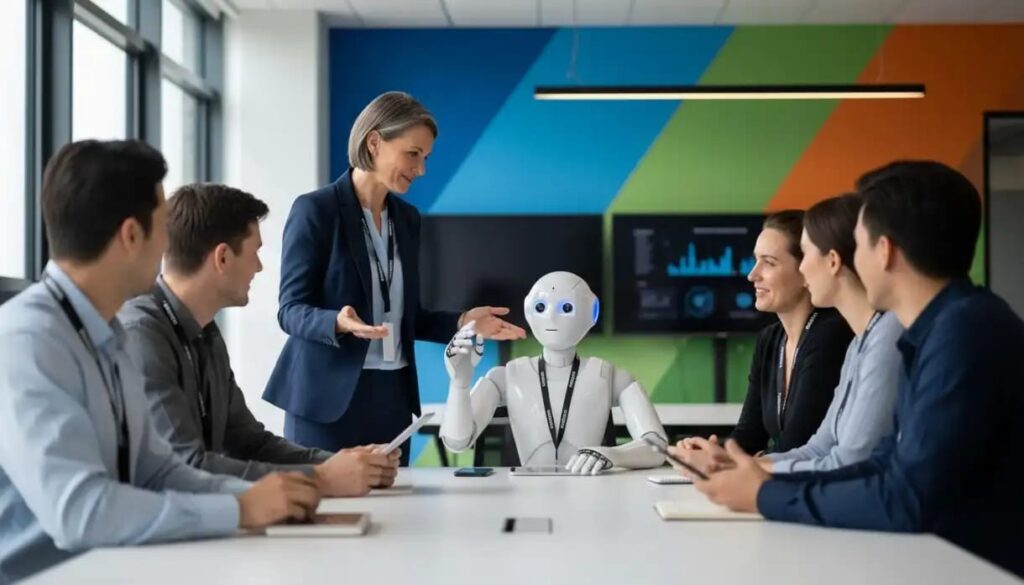
Traditional AI tools respond to single prompts. Multi-agent AI systems work differently. They deploy networks of specialized agents, where one gathers data, another generates insights, and another executes actions. Together, they manage end-to-end workflows without waiting for human input at every step.
Analysts project that 80% of enterprise applications will embed AI agents by 2026. Furthermore, agentic AI adoption is growing at a compound annual rate exceeding 46%. That growth is already visible across sales, finance, customer support, and supply chain management.
So what makes agentic AI structurally different from earlier tools? The answer is sustained execution. Frontier models now reason across long-running, multi-step workflows. They invoke tools, interpret results, and iterate over time. As a result, entire segments of business operations are shifting from human-executed to autonomously executed.
Google stands as one of the clearest examples of this shift. At Google Cloud Next 2026, the company announced a sweeping push into the agentic enterprise. Thomas Kurian, CEO of Google Cloud, declared during his keynote: “Today, that future is in-production, the Agentic Enterprise is real, and deployed at a scale the world has never before seen.”
The numbers back that claim. Google’s first-party models now process more than 16 billion tokens per minute through direct API use, up from 10 billion just one quarter prior. Additionally, nearly 75% of Google Cloud customers actively use AI products. Gemini Enterprise also recorded 40% growth in paid monthly active users in Q1 alone.
Beyond metrics, Google is committing serious capital. The company launched a $750 million innovation fund to accelerate agent development globally. Partners, including Accenture, McKinsey, Deloitte, and BCG, will receive early access to upcoming Google DeepMind models as part of the program.
Through the Gemini Enterprise Acceleration Program, Accenture and Google Cloud are deploying specialized AI agents at scale. Thousands of AI-skilled engineers and industry domain experts are working together. Their goal is to transform workflows across customer engagements and entire value chains.
Real-world results are already emerging. Citi Wealth launched Citi Sky, an always-on AI-powered financial advisor built with Google Cloud and Google DeepMind. Home Depot now uses AI voice agents to replace rigid phone menus with intent-driven conversations. Meanwhile, Merck is deploying an agentic platform valued at up to $1 billion across its research, manufacturing, and commercial operations.
Google DeepMind also released a new generation of autonomous research agents. Built with Gemini 3.1 Pro, Deep Research Max blends the open web with proprietary data streams. It delivers professional-grade research workflows and integrates directly into Gemini App, NotebookLM, Google Search, and Google Finance.
However, the rapid rise of multi-agent AI systems brings real governance concerns. Without proper orchestration, scaling AI multiplies risk instead of value. Weak governance and security gaps surface first, often because many agents have limited access to internal infrastructure.
To address this, Google introduced Agent Identity. It assigns every agent a unique cryptographic ID, along with defined authorization policies and a fully auditable trail. Agent Gateway then enforces security policies and protects against prompt injection, tool poisoning, and data leakage. Clearly, governance is no longer optional, it is foundational.
Still, the market opportunity is enormous. The global AI market will exceed $800 billion by 2030. Organizations that ignore autonomous workflows risk falling behind competitors whose digital workers never sleep and never stop improving.
Ultimately, the shift toward multi-agent AI systems is more than a technology story. It is a story about how work itself is being redefined. The businesses moving now are not experimenting, they are scaling. And 2026 is proving to be the year the gap between early adopters and everyone else begins to widen decisively.
Writer: Princely OriomojorÂ