It Is Legally an E-Bike. It weighs 176 Pounds and goes 33 mph.
Quick Reads
- The Infinite Machine Olto is a $3,495 electric vehicle that meets the legal definition of a Class 2 e-bike, requiring no licence, registration, or insurance in most US cities
- It weighs 176 pounds, has a 750W rear hub motor, seats two passengers, and can reach 33 mph in off-road mode with up to 40 miles of range on a single swappable battery
- Features include GPS tracking, over-the-air firmware updates, NFC key access, automatic steering lock, integrated lights and turn signals, and a full accessory ecosystem
- Backed by $14.2 million from a16z’s American Dynamism fund, the Olto is designed as a genuine car replacement for urban commutes, though actual cyclists in bike lanes have concerns
The first thing that hits you about the Infinite Machine Olto is that calling it an e-bike feels like a joke. A very legal joke, but a joke. Found itself asking the same question that everyone who rides this thing asks: Is this really a bicycle?
The answer is technically yes. The Olto qualifies as a Class 2 e-bike in most US jurisdictions, meaning no licence, no registration, no insurance required, and bike lane access permitted. That classification rests on the fact that it has pedals, a throttle limited to 20 mph in Class 2 mode, and it meets the relevant weight and motor thresholds. In practice, it was confirmed that reviewers hit 36 mph in testing. The pedals are essentially vestigial, with Infinite Machine CEO Joseph Cohen reportedly advising riders not to bother using them, and the chain on demo units arriving visibly rusted.
What the Olto actually is is a moped that found a legal loophole. New York-based Infinite Machine, backed by $14.2 million from a16z’s American Dynamism fund, was founded by brothers Joseph and Eddie Cohen after years of riding Vespas around New York, convinced that two-wheeled transport was genuinely superior for city movement. The P1, their electric moped for car lanes, came first. The Olto followed as the bike lane version of the same philosophy.
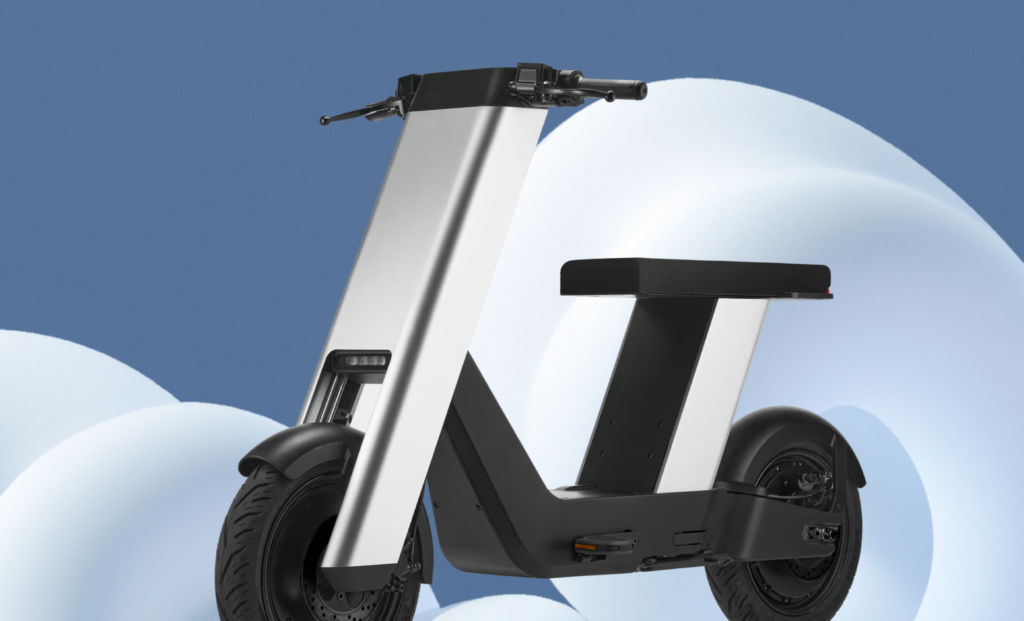
The design is striking. Inside EVs called it what it would look like if Apple, Tesla, or Rivian made an e-bike. Angular, minimal, with no visible cabling and a step-through frame that reads as futuristic rather than industrial. The seat is built for two, with hidden fold-out passenger footpegs that pop in and out on demand. A weatherproof construction means it is designed to live outside, which matters given it weighs too much to carry up most apartment stairs.
The tech stack is genuinely impressive for a two-wheeled vehicle. Connectivity runs through Bluetooth and cellular independently, meaning GPS tracking and alarm alerts remain active even when the main battery is removed. An internal 12V backup battery runs security systems for weeks on its own. Ride unlock is via NFC card or smartphone proximity. Over-the-air firmware updates mean the software can improve without a trip to a service centre. An accessory ecosystem covers child carriers, cargo bins, racks, and phone mounts.
It captured the honest tension around the Olto well. It is fun, fast, smooth, and turns heads at every traffic light. It is also heavy enough that anyone expecting an e-bike experience will be surprised, and light enough for actual cycling that dedicated riders in bike lanes are already wondering what it means for the shared lane social contract. The Olto does not replace a bicycle. It replaces a short car trip. At $3,495, for the right urban commuter, that trade makes real sense.