Artemis II crew breaks Earth orbit and heads for the moon
Quick Reads.
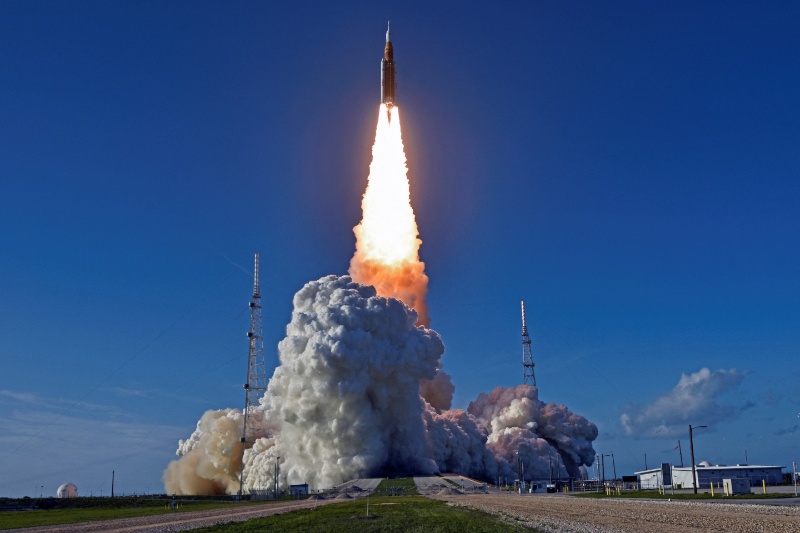
- NASA’s Artemis II launched on Wednesday, April 1, from Kennedy Space Center in Florida, sending four astronauts on a historic 10-day journey around the moon.
- The crew fired their main engine on Thursday night, executing a flawless translunar injection burn that pushed the Orion capsule out of Earth’s orbit and onto a course for the moon at more than 24,000 mph.
- The crew, NASA’s Reid Wiseman, Victor Glover, and Christina Koch, and Canadian astronaut Jeremy Hansen, are set to fly by the moon on approximately April 6.
- Glover, Koch, and Hansen have already made history as the first Black person, first woman, and first non-American, respectively, to travel toward the moon.
- Splashdown in the Pacific Ocean is expected on April 10, 2026, with the crew set to break the all-time human distance record from Earth set by Apollo 13 in 1970.
Four astronauts are now on their way to the moon. The Artemis II crew completed a critical engine burn late Thursday night that propelled their Orion spacecraft out of Earth’s orbit, making them the first humans to leave low-Earth orbit since Apollo 17 in December 1972. NASA science chief Lori Glaze confirmed the five-minute-55-second translunar injection burn went “flawlessly,” and Canadian mission specialist Jeremy Hansen reported the crew was “feeling pretty good up here on our way to the moon,” according to BBC News.
The mission lifted off at 6:35 p.m. ET on Wednesday, April 1, from NASA’s Kennedy Space Center in Cape Canaveral, Florida. The 322-foot Space Launch System rocket carried the Orion crew capsule skyward before tens of thousands of spectators gathered near the launch site, according to Al Jazeera. Engineers managed several technical issues before and during the countdown, including a hydrogen fuel monitoring concern, a battery sensor reading, and a temporary communications failure with the rocket’s flight-termination system, but all were resolved without delaying liftoff.
The crew spent the first 25 hours in high Earth orbit running thorough checks of Orion’s life-support, propulsion, navigation, and communications systems before NASA cleared them for lunar departure, the Associated Press reported via PBS NewsHour. Commander Reid Wiseman described the magnitude of the moment after the engine firing: “I’ve got to tell you, there is nothing normal about this. Sending four humans 250,000 miles away is a herculean effort, and we are now just realizing the gravity of that.”
If the mission proceeds as planned, Orion will reach its closest lunar approach of approximately 4,000 to 6,000 miles above the surface on April 6, before swinging back on a free-return trajectory, a gravity-assisted arc requiring minimal fuel, toward Earth. During the flyby, the crew will receive an unobstructed view of the lunar far side and witness a total solar eclipse as the moon passes between Orion and the sun. The mission is also set to break the farthest-distance-from-Earth record held by Apollo 13 since 1970. Splashdown in the Pacific Ocean is expected on April 10.
The Artemis II mission does not include a lunar landing. That milestone is targeted for Artemis III, currently planned for 2027, which will dock with a lander in Earth orbit before transporting two astronauts to the lunar surface. NASA has described Artemis II as the critical test flight needed to certify Orion for deep-space human missions and to ultimately build a sustained lunar presence ahead of future crewed Mars exploration.