Artemis II Crew Becomes the Farthest Humans from Earth in Recorded History
Quick Reads
- NASA’s Artemis II crew became the farthest humans from Earth in history on Monday, April 6, 2026, surpassing a record that stood for 56 years.
- The four astronauts aboard NASA’s Orion spacecraft crossed 400,171km (248,655 miles) from Earth at 15:58 GMT, eclipsing the mark set by the crippled Apollo 13 mission in 1970.
- The crew went on to reach a maximum distance of approximately 406,788km (252,760 miles) from Earth later Monday evening as Orion swung around the far side of the moon.
- The mission includes historic firsts: Victor Glover is the first person of colour to fly around the moon, Christina Koch the first woman, and Jeremy Hansen the first non-American.
- Orion is on course for splashdown in the Pacific Ocean near San Diego on Friday, April 10, nine days after its April 1 launch from Kennedy Space Center in Florida.
Four astronauts aboard NASA’s Artemis II mission rewrote the record books on Monday, travelling farther from Earth than any human before them as their Orion spacecraft completed a sweeping flyby of the moon. The milestone arrived six days into the mission, on April 6, 2026, when the crew crossed beyond 400,171 kilometers (248,655 miles) from Earth, the distance Apollo 13 reached in 1970 not by design, but by disaster.
With the moon looming ever larger, the Artemis II astronauts raced to set a new distance record from Earth on a lunar fly-around promising magnificent views of the far side never seen before by the human eye. By the time Monday was over, Mission Control expected Artemis II to beat Apollo 13’s mark by more than 4,100 miles (6,600 kilometers), with NASA confirming a maximum distance of approximately 406,788 kilometers (252,760 miles).
A Day That Began With the Voice of the Past
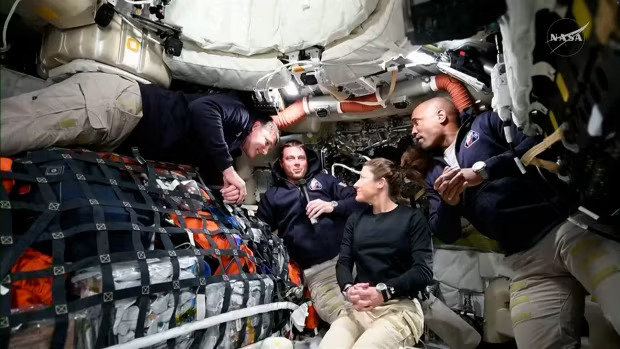
The crew, Commander Reid Wiseman, pilot Victor Glover, mission specialist Christina Koch, and Canadian Space Agency astronaut Jeremy Hansen, began Monday with a recording from Apollo 13 commander Jim Lovell, who had taped the message shortly before his death last August. “Welcome to my old neighborhood,” Lovell told them. “It’s a historic day and I know how busy you’ll be, but don’t forget to enjoy the view.”
The crew carried with them the Apollo 8 silk patch that Lovell had taken to the moon, displaying it as the critical flyby drew close. “It’s just a real honour to have that on board with us,” Commander Wiseman said. “Let’s go have a great day.”
Eyes That No Camera Can Replace
The six-hour flyby is the centerpiece of this ten-day mission. The Artemis II crew took in magnificent views of the far side of the moon, views never before witnessed by human eyes, while also setting a new distance record for humanity.
Among the sights captured was the Orientale basin, a crater nearly 600 miles wide straddling the moon’s near and far sides, previously only photographed by uncrewed orbiting cameras. During the flyby, a fleet of cameras captured imagery of the moon, including features humans have never directly seen, while the astronauts used a variety of digital handheld cameras to conduct high-resolution photography of the lunar surface. Dozens of lunar scientists at NASA’s Johnson Space Center in Houston, Texas, monitored in real time as the crew described what they observed.
For roughly 40 minutes, all communication with Artemis II was cut off as the astronauts passed behind the moon. During that blackout, the crew was on track to make their closest approach to the moon, 4,067 miles (6,545 kilometres), and to reach their maximum distance from Earth.
Grief, Honour, and a Moment That Stopped Mission Control
Moments after breaking the record, the crew asked permission to name two previously unnamed lunar craters they had observed. The first, Integrity, was named after their Orion spacecraft. The second carried a heavier weight. They proposed Carroll, in honour of Commander Wiseman’s wife, who died of cancer in 2020. The four astronauts were visibly moved, and the moment was broadcast live to the world.
Canadian astronaut Jeremy Hansen, speaking from the cabin of Orion, marked the record with a statement directed at generations to come: “We will continue our journey even further into space before Mother Earth succeeds in pulling us back to everything that we hold dear. But we most importantly choose this moment to challenge this generation and the next to make sure this record is not long-lived.”
From Mission Control, capsule communicator Jenni Gibbons responded: “Today, for all humanity, you’re pushing that frontier.”
The Road Home, and What Comes After
Known as a free-return lunar trajectory, Artemis II’s route takes advantage of Earth and the moon’s gravity in a celestial figure-eight, reducing the need for fuel and putting the astronauts on course for home once they emerge from behind the moon. The Orion capsule is expected to splash down off the coast of San Diego on Friday, April 10.
Artemis II sets the stage for next year’s Artemis III, which will see another Orion crew practice docking with lunar landers in orbit around Earth, with a culminating moon landing near the lunar south pole to follow on Artemis IV in 2028.