Alibaba Just Turned Your Car Into a Chatbot.
Quick Reads
- Alibaba announced at the opening of the 2026 Beijing Auto Show that its Qwen AI model will be integrated into vehicles.
- Drivers will be able to order food delivery, book hotels, buy attraction tickets, and track packages using only voice commands, all powered by Alibaba’s ecosyste.m
- The system runs on Nvidia’s automotive chip and is designed to work with limited connectivity.
- The announcement positions Alibaba against ByteDance’s Doubao and iFlyTek in the race to control the in-car AI experience in the world’s largest car market.
The next frontier for AI assistants is not your phone. It is not your laptop. It is the dashboard in front of you during your commute, and Alibaba just made the loudest claim on that territory yet.
Chinese tech giant Alibaba said its Qwen artificial intelligence model will be integrated into vehicles from automakers including BYD and a local joint venture of Volkswagen, as the industry pushes to add more in-car digital services and compete for buyers in a slowing electric vehicle market. from the 2026 Beijing Auto Show floor, where the announcement dropped on the opening day of the event, the world’s largest automotive exhibition this year, with over 2,000 companies from 21 countries.
Auto companies integrating Qwen into their vehicle systems include BYD, Geely, Li Auto, Changan, Dongfeng, BAIC, Great Wall Motor, SAIC Volkswagen and SAIC IM Motors.: That is nine brands across domestic and joint venture lines, covering a substantial slice of China’s passenger vehicle market. Earlier this year, FAW Group’s Hongqi brand had already integrated Qwen into its in-car system, debuting in the Hongqi HS6 plug-in hybrid model.
The capability set goes well beyond setting reminders or playing music. Select models will allow drivers to order food delivery, book hotels, buy tickets to attractions and track packages, among other features, through voice commands. In-car implementation supports hands-free ordering, hotel and ticket bookings, package tracking, and payments via Alipay, alongside a previously announced AI Taxi feature for natural-language ride-hailing and payment. W.Media That level of transactional integration, linking the car directly to Alibaba’s e-commerce, travel, and logistics arms, is something Western rivals, including Google, Apple, and Amazon, cannot replicate in China the same way. The ecosystem advantage is the entire point.
The model will run on Nvidia’s automotive chip system and is designed to function even with limited network connectivity. The automotive stack mixes on-device processing for routine commands with cloud-based servers to handle heavier planning and multi-step task execution when connectivity is available. That hybrid approach is a practical engineering choice, not just a marketing claim. Voice assistants that lag or drop in tunnels and parking structures become a friction source, not a feature. On-device processing for simpler intents keeps the experience consistent regardless of signal.
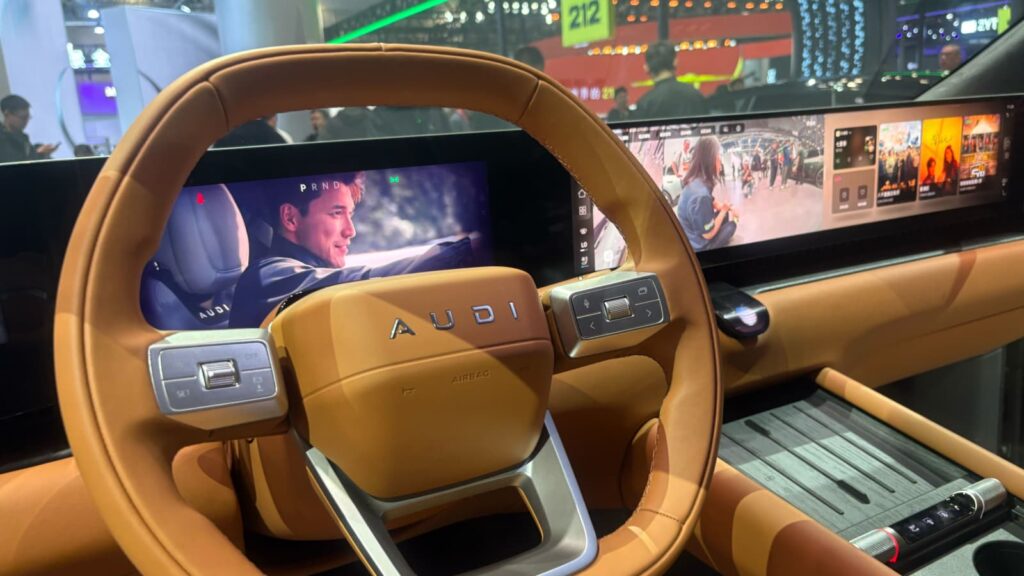
Alibaba is not alone in this race. A local version of Audi in China said its second model, an electric SUV called the E7X, will incorporate AI features from ByteDance’s Doubao and iFlyTek. Reporting from the show floor found Volkswagen, Hyundai, Cadillac, and Nissan all making AI-related announcements, with foreign brands increasingly leaning on Chinese tech partners to win back buyers they have been steadily losing to domestic competitors.
The deeper story is what this means for who controls the data inside the vehicle. A car with Qwen integration is a moving data collection point capturing voice commands, location, purchasing behaviour, travel patterns, and potentially biometric readings from driver-facing cameras. For more complex requests, the system offloads reasoning to the cloud-based Qwen, which can browse the internet, compare prices, and authorise payments via Alipay. Angel One, every one of those transactions leaves a data trail. Who that data belongs to, how it is stored, and what regulatory oversight applies are questions the Beijing Auto Show announcements did not fully answer.
The world’s largest car market is now also its most competitive laboratory for in-car AI. Alibaba, at least for this week, has the most names on the partner list.