The Wire That Could Replace Copper Just Became Real.
Quick Reads
- Spanish researchers at IMDEA Materials have produced carbon nanotube fibres with electrical conductivity.
- The breakthrough uses a chemical dopant called tetrachloroaluminate to boost conductivity more than 17 times over previous CNT fibres.
- The resulting wires are five times stronger and half the weight of conventional overhead cables,
- Copper demand is expected to rise by 50 per cent by 2040 to meet clean energy needs.
Copper has been the material of choice for electrical wiring for over two centuries. It conducts electricity well, it is flexible, it is durable, and it has been cheap enough to use on a massive scale. But demand for copper is rising faster than the world can mine it. Every electric vehicle, every solar installation, every AI data centre, every transmission grid expansion requires more of it. The gap between what is needed and what is available is closing fast, and researchers have been racing to find something better
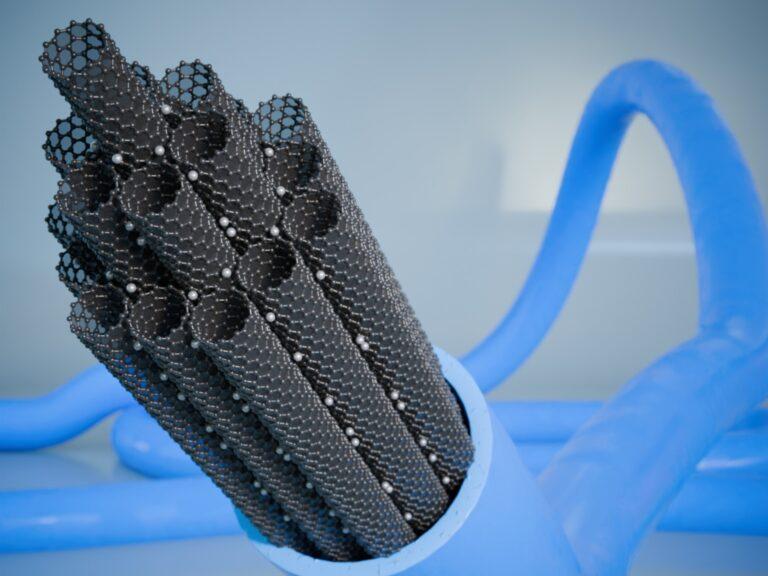
Researchers at the IMDEA Materials Institute, working with the Technical University of Madrid and the University of Zaragoza, demonstrated for the first time a scalable manufacturing process for carbon nanotube fibres with electrical conductivity comparable to that of copper and aluminium, publishing their results in the journal Science. Carbon nanotubes have been theoretically superior to copper for years. The problem has always been making them work at scale. Individual carbon nanotubes conduct electricity exceptionally well, but bundled into usable fibres, the resistance between tubes collapses that performance. Every time researchers got close, they hit the same ceiling.
The IMDEA team got past it using a chemical doping agent. By introducing tetrachloroaluminate into the CNT fibre array, the team achieved a more than 17-fold increase in electrical conductivity of the bulk fibres. The dopant was introduced without disrupting the original structure of the CNT bundles, which meant conductivity improved while the exceptional mechanical properties of the fibres were preserved. That combination, high conductivity and high mechanical strength in the same material, is what makes this result different from what came before. Previous attempts at improving CNT conductivity through doping often worked in the lab but fell apart when subjected to real-world conditions like heat, vibration, or sustained current loads.
The doped CNT fibres would be five times stronger than conventional overhead cables, while being half the weight. For aerospace and drone applications, that is not a marginal improvement. Weight in aircraft directly translates to fuel consumption, range, and payload capacity. A wiring harness that weighs half as much and carries the same current with no performance loss changes the engineering calculus for an entire class of vehicles. Other CNT-copper composite approaches have shown 30 per cent higher specific conductivity and 120 per cent higher specific ampacity compared to conventional copper, suggesting researchers are converging on multiple viable paths from different directions.
The research team noted this is particularly significant for the electrification of transport, including EVs, drones, and aircraft, which require large numbers of conductors at the lowest possible weight. It also holds promise for overhead power cables, which are often limited by their own weight.
The supply picture is what gives this urgency beyond the laboratory. IEA analysis has flagged a potential primary copper supply deficit starting as early as 2025, with clean energy demand expected to push global refined copper consumption from roughly 26 million tonnes in 2023 to around 40 million tonnes by 2040. Continuous CNT cables several kilometres long have already been produced, offering higher conductivity than copper, superior thermal and mechanical resistance.
This is not a product announcement. It is a research milestone, and an honest one. The path from a result published in Science to a kilometre of cable being installed in an electric aircraft is long and expensive. But the question for twenty years has been whether carbon nanotubes could ever realistically match copper at scale. The answer this week is yes.