Japan Airlines Robots Now Handle Luggage at Haneda
The future of airport ground handling just got a face, two arms, and a job. Japan Airlines is putting humanoid robots to work, and this is not a distant experiment. It starts next month.
Japan Airlines has announced a robot demonstration experiment at Tokyo’s Haneda Airport, where humanoid robots will join baggage handlers starting in May 2026. The trial runs in partnership with GMO AI and Robotics, and will last through 2028.
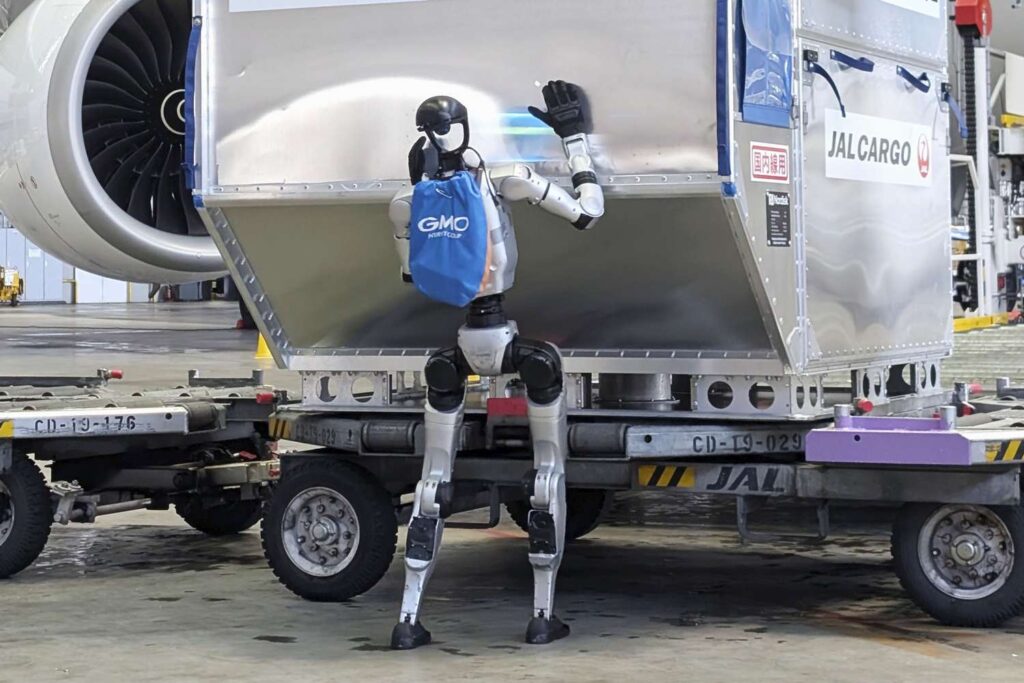
The humanoid robots are manufactured by Hangzhou-based Unitree. They stand 130cm tall and handle travellers’ luggage and cargo on the tarmac at an airport that processes more than 60 million passengers annually.
During a media demonstration this week, one robot was observed pushing cargo onto a conveyor belt next to a Japan Airlines passenger aircraft and waving to workers. The machines operate continuously for two to three hours before requiring recharging breaks. Because of this, they work best as supplemental staff rather than full replacements.
The phased approach begins with workflow analysis, then simulated tests, targeting baggage and cargo loading, cabin cleaning, and ground support equipment operation.
Japan Airlines Humanoid Robots Address a Real Crisis
Japan’s labour problem is severe and getting worse. Japan Airlines decided to test humanoid robots specifically to save labour while leveraging existing facilities, avoiding costly infrastructure overhauls.
More than 7 million people visited Japan in the first two months of 2026, following a record 42.7 million visitors in 2025. This surge places additional strain on airport staff already stretched thin by workforce constraints. CP24
Tomohiro Uchida, president of GMO AI and Robotics, explained the problem plainly. “While airports appear highly automated and standardised, their back-end operations still rely heavily on human labour and face serious labour shortages,” he said.
Therefore, the robots are not about cutting jobs. They are about filling gaps that human workers simply cannot cover. Japan is currently projected to require 6.5 million foreign workers by 2040 to meet its economic growth targets.
The JAL trial has a clear roadmap. In 2027, robots will move to integrated tasks. If Japan’s Ministry of Land, Infrastructure, Transport and Tourism grants safety certification by December 2026, robots will move to live tarmac operations in early 2027.
However, Yoshiteru Suzuki, president of JAL Ground Service, was careful to draw limits. He noted that some duties, including safety management, can only be handled by humans. The robots are designed to work alongside staff, not above them.
Travellers won’t interact directly with the machines. Robots will load and unload baggage and cargo behind the scenes at Haneda, potentially speeding up bag delivery.
Meanwhile, GMO opened a dedicated humanoid research facility in Shibuya this month. The facility supports the airport trial directly. As a result, this is not just a JAL experiment. It is a national infrastructure investment dressed up as a luggage trolley.