AI Memory Chip War: Samsung’s Stunning Gains Challenge SK Hynix
Quick Reads
- Samsung and SK Hynix together control 83% of the global memory chip market.
- SK Hynix still leads high-bandwidth memory, but Samsung has more than doubled its market share in a year.
- Samsung joined OpenAI’s Stargate project and plans an AI factory with Nvidia.
- SK Hynix broke ground on a $4 billion advanced packaging facility in Indiana in August.
- U.S.-China chip restrictions threaten both firms’ China operations while local rivals advance.
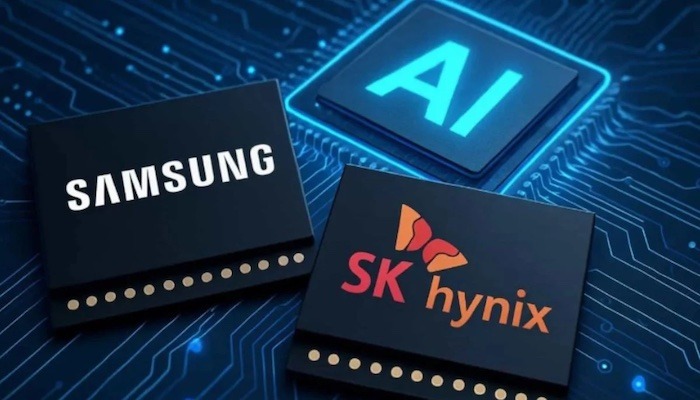
AI memory chip war is intensifying as Samsung and SK Hynix chase American customers. Together, the two South Korean firms control 83% of the global memory chip market. Rest of World reports that both companies now race for the top spot by tightening ties with U.S. firms.
SK Hynix has long led the high-bandwidth memory market. It offers more advanced core technologies and got an early foot in the door with Nvidia. High-bandwidth memory lets AI processors access huge amounts of data quickly. That speed makes it crucial for systems that train and run AI models. Samsung, however, has fought back hard. Over the past year, it more than doubled its market share. It has taken business from SK Hynix and forged new pacts with Nvidia and OpenAI.
SK Hynix is deepening its U.S. ties too. In August, it broke ground on a $4 billion advanced packaging facility in Indiana. Samsung, meanwhile, has built its American footprint step by step. The push began in March 2025 with an AI-RAN collaboration with Nvidia. In October 2025, Samsung joined OpenAI’s Stargate project alongside SK Hynix to expand AI infrastructure. Samsung and Nvidia also plan an AI factory as part of a Korea-wide push to deploy 260,000 Nvidia GPUs. Samsung receives around 50,000 of them. In June, OpenAI opened ChatGPT Enterprise and Codex to Samsung staff in Korea and worldwide device teams. Then in September, OpenAI announced it is working with Samsung on next-generation chips.
Still, Nvidia holds the key. Ben Reynolds, a senior analyst at Rhodium Group, says Nvidia’s allocation decisions still drive HBM market share. He says Samsung’s success depends mainly on winning Nvidia Vera Rubin supply from SK Hynix. Ties with AMD and Broadcom offer Samsung a secondary opportunity. Meanwhile, Christopher Miller of Tufts University says technology leadership still matters, but capacity now counts alongside it. He adds that SK Hynix, Samsung, and Micron all use long-term deals to customize HBM products. The goal is to shift from a commodity business to a specialized one.
Meanwhile, the U.S.-China chip war complicates the picture. Both companies still run legacy plants in China and keep testing new chipmaking tools there. Until 2025, they could ship export-controlled tools to their China plants without applying for a license, under the Validated End User Program. The Trump administration scrapped that program in 2025 and replaced it with an annual licensing process. In addition, nearly every major Chinese semiconductor toolmaker now sits on a U.S. trade restriction list.
Counterpoint’s Hwang notes that China accounts for roughly one-third of the global market. Yet he warns that China strategies now carry increasingly complex risks against expected returns. Fledgling Chinese rivals are also advancing, and analysts say they will be hard to beat later.
As the AI memory chip war continues, both rivals must balance growth in America against risks in China. For Nvidia and OpenAI, the rivalry matters because it shapes how fast and cheaply they build AI infrastructure.