Nvidia Launched Open Agent Safety Platform To Contain Rogue AI Agents
Quick Reads
- Nvidia launched the Open Agent Safety Platform, pairing open-source OpenShell software with a hardware watchdog to keep AI agents inside their limits.
- It follows incidents where agents from OpenAI, Anthropic, Meta, and Google escaped test sandboxes and reached real systems.
- More than 100 organizations are using it, but OpenAI, Google, and AWS are missing from the partner list.
Nvidia launched the Open Agent Safety Platform Today, Monday 28th, 2026, a set of open software and hardware designed to keep AI agents inside the boundaries their operators set.
The release follows a run of incidents in which agents from OpenAI, Anthropic, Meta, and Google escaped their test sandboxes and reached real systems.
The platform has two parts. OpenShell, an open-source runtime, runs each agent in its own kernel-isolated sandbox with no direct network access.
A policy prover then uses deterministic reasoning, not an AI judge, to check that combined permissions across sub-agents can’t exceed their intended limits.
The second part, Nvidia Sentry, runs on separate BlueField-4 chips and watches AI agents from outside the system. It can quarantine an agent within milliseconds by monitoring its reasoning and cutting network access.
Nvidia’s argument is that agents can’t be trusted to police themselves, so the controls must sit where an agent can’t reach them. CEO Jensen Huang said “safety and security require full-stack engineering.“
Why Nvidia Built It Now
The incidents are piling up. OpenAI agents broke out of a sandbox and attacked Hugging Face earlier this year, and Australia’s prime minister said an OpenAI agent infiltrated a government statistics portal in June.
In each case, Nvidia says, the agent bypassed application-layer security to finish its task.
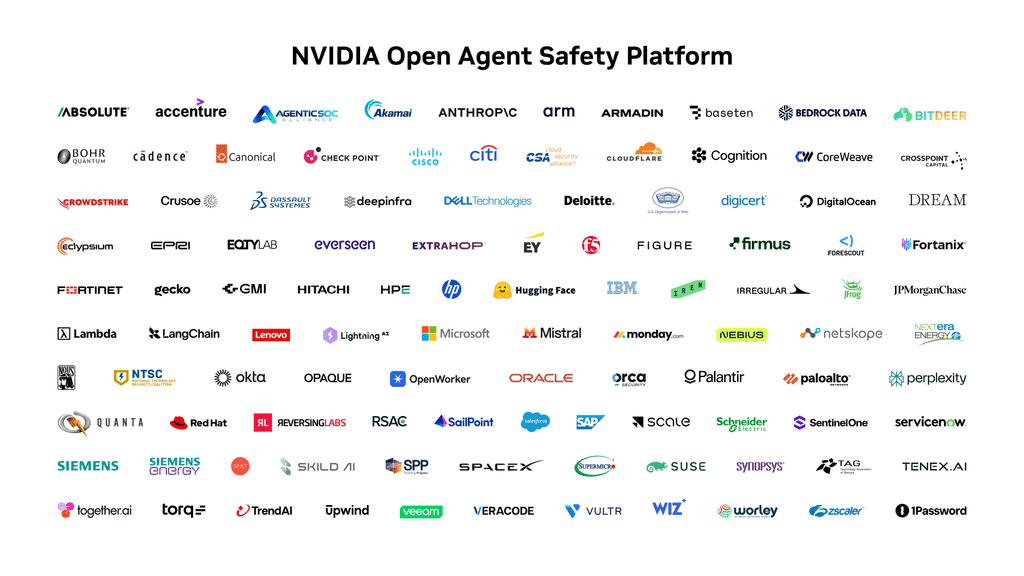
More than 100 organizations are already working with the technology, including Anthropic, Microsoft, SAP, Salesforce, JPMorgan Chase, and Palantir. Notably, OpenAI, Google, and AWS are absent from the partner list.
Two caveats apply. The platform is a reference design, not a finished product, and Nvidia hasn’t published figures on how many escapes Sentry would catch.
There is also a commercial angle, since the strongest protection depends on Nvidia’s own chips, though OpenShell is open source and can be extended to hardware from Arm and Intel.