AI Eval Hygiene Is the Line Between a Working Agent and a Production Failure
Anthropic, of all companies, just shipped three quality regressions in Claude Code that its own evals didn’t catch. That single fact should alarm every engineering team building AI into production. If it can happen to the makers of Claude, it will happen to you.
In a refreshingly candid postmortem, Anthropic walked through what went wrong. On March 4, the team reduced Claude Code’s default reasoning effort. Then on March 26, a caching bug cleared context on every turn instead of after an idle hour. Finally, on April 16, two lines of system prompts asking Claude to be more concise turned out to reduce coding quality by 3%, but only on a broader test suite that wasn’t part of the standard release gate. None of it triggered an internal flag. Users, however, noticed almost immediately.
The lesson is not that Anthropic is careless. Rather, it’s that AI quality is genuinely slippery, even for teams that obsess over measurement. This is precisely why AI eval hygiene for production agents has become a critical engineering discipline, not a nice-to-have.
Andrej Karpathy coined the term “vibe coding” to portray the process of describing what you want, letting the model toil away, and trying not to look too closely at the resultant mess. That’s fine for prototypes, but it’s a terrible way to build production software. Unit tests, integration tests, and regression suites became standard because eventually the cost of guessing exceeded the cost of measuring. AI is reaching that same crossroads.
A good AI eval is not simply a test suite. It forces a team to define in advance what good behavior looks like, what failure looks like, and what variance the business can tolerate. Anthropic’s eval guidance for agents draws a useful distinction between pass@k (the agent succeeds at least once across k tries) and pass^k (it succeeds every time across k tries). That distinction matters enormously in production. A task that succeeds 75% of the time produces only a 42% success rate across three consecutive runs. That’s not a rounding error, that’s the difference between a demo and a product.
Furthermore, AI eval hygiene for production agents must account for how AI breaks classical testing assumptions. Angie Jones, who formerly led AI tools at Block, has long argued that classical test automation assumes “the exact results must be known in advance” so you can assert against them. With machine learning, “there is no exactness, there is no preciseness. There’s a range of possibilities that are valid.”
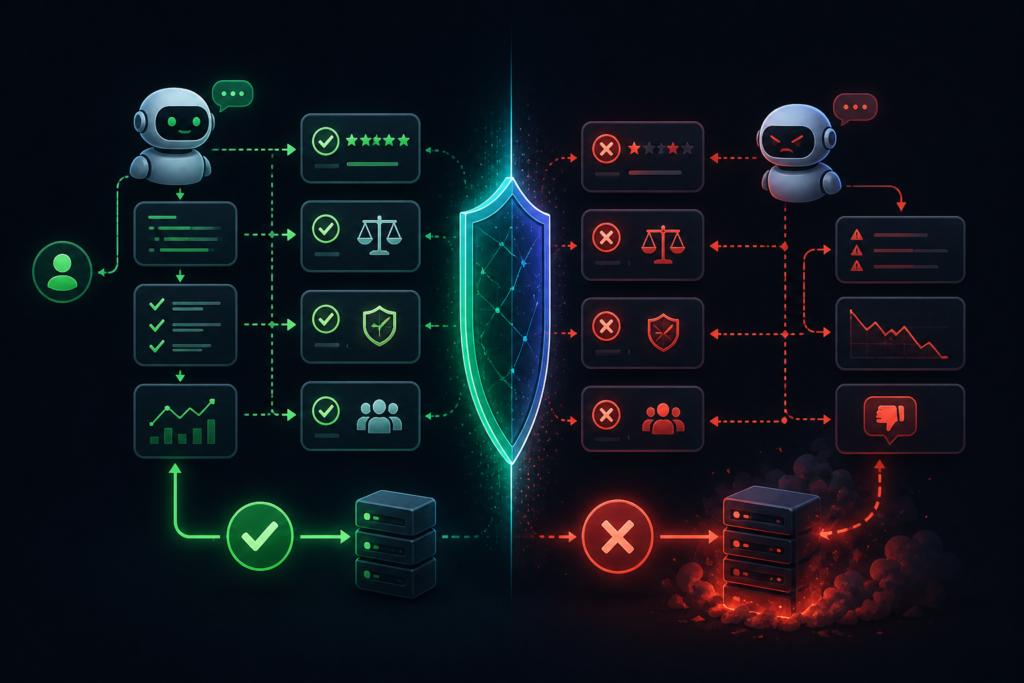
The solution is a clear improvement loop. A production complaint becomes a trace, a trace becomes a failure mode, a failure mode becomes an eval, an eval becomes a regression test, and a regression test becomes a release gate. Only then should you change the prompt, swap the model, or tune the cost-latency trade-off.
LangChain’s April update shipped more than 30 evaluator templates covering safety, response quality, trajectory, and multimodal outputs, plus cost alerting and a serious push toward human judgment in the agent improvement loop. The industry is converging on the same realization: the eval is the product.
Still, bad evals are arguably worse than no evals. Teams that wire up dashboards without calibration against real user behavior end up with false confidence. As InfoWorld contributor Matt Asay writes, pointing to the dashboard and saying “But the evals are green” does nothing but demonstrate denial at scale.
Ultimately, the teams that will win the next phase of AI won’t have the fanciest dashboards. They’ll simply have the most honest feedback loops, and they’ll know when their agent is actually getting better.