Hormuz Blockade Oil Surge: Oil Tops $103 as US-Iran Talks Fail
QUICK READS
- Brent crude surged more than 8% on Sunday, crossing $103 a barrel after US-Iran peace talks in Islamabad ended without a deal.
- US WTI crude also jumped roughly 8%, rising above $104 per barrel in early trading.
- President Trump ordered the US Navy to blockade the Strait of Hormuz, escalating the six-week-old conflict with Iran.
- S&P 500 futures fell 1%, Nasdaq 100 futures slid 1.3%, and the dollar rose 0.3% against major peers in early Monday trade.
- Analysts at JPMorgan Chase warn that pre-closure oil barrels are nearly exhausted, making reopening the strait the market’s most time-sensitive priority.
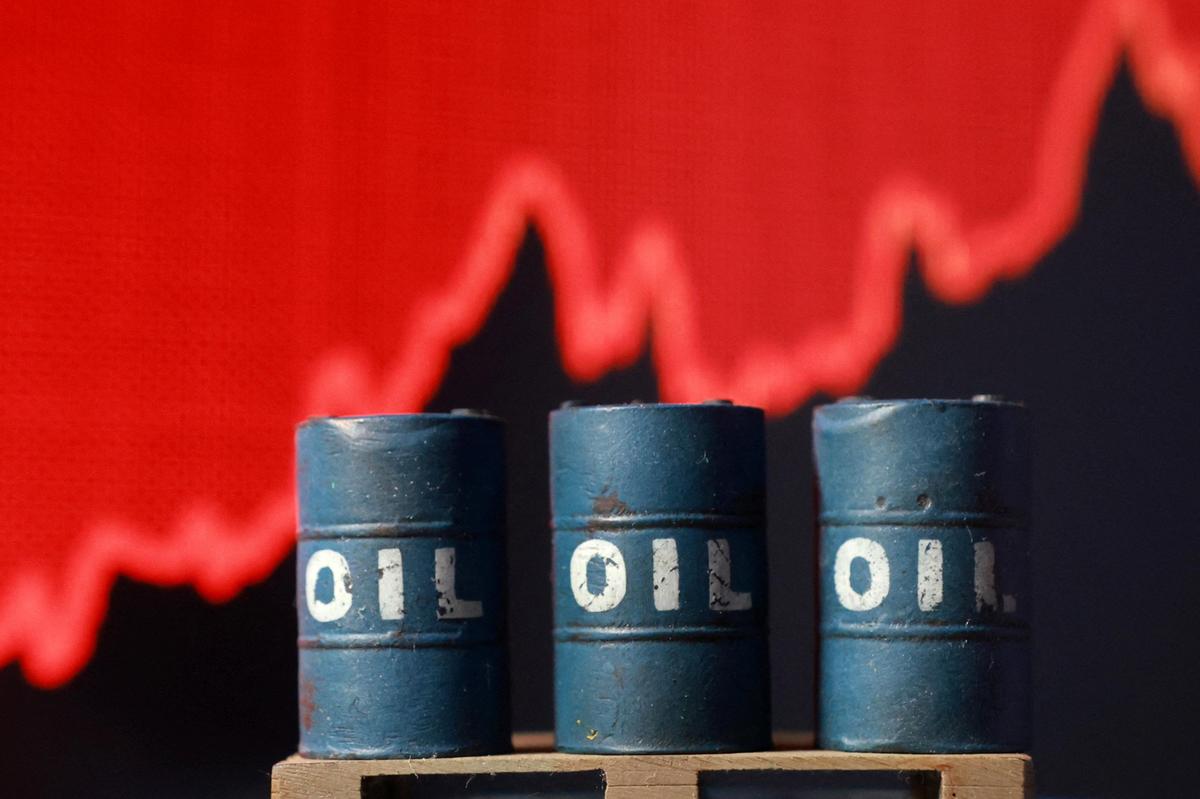
Global oil prices surged sharply on Sunday night and into Monday after the United States and Iran failed to reach a peace deal in Islamabad. President Donald Trump then ordered a full naval blockade of the Strait of Hormuz. Brent crude, the international benchmark, crossed $103 per barrel. WTI, the US benchmark, rose above $104. Both moves represent an approximate 8% single-session jump, erasing most of the price relief that followed last week’s fragile ceasefire.
What Broke Down in Islamabad
US Vice President JD Vance led the American delegation through nearly 21 hours of talks hosted in Pakistan. He announced their departure on Sunday, saying Iran had not provided the one thing Washington demanded: a firm commitment to abandon its nuclear weapons programme.
“Negotiators will return to the US without a deal after Iran didn’t give a commitment it wouldn’t seek a nuclear weapon,” Bloomberg reported, citing the VP’s statement.
Iran’s foreign ministry did not fully close the door. It signalled the possibility of future discussions, which analysts say is the key nuance. As Dionissios Kontos, co-founder of Meyka AI, noted in Bloomberg’s market wrap: “This isn’t a full collapse, just prolonged uncertainty. That matters for how violent or measured Monday’s reaction is.”
The failure is particularly painful for investors. Last week’s ceasefire announcement struck on April 8 had briefly pushed oil below $100 a barrel. Stocks climbed. The Bloomberg Dollar Spot Index fell 0.8%, its worst day since January. That entire relief trade now unravels.
Hormuz Blockade Oil Surge Rattles Global Markets
The geopolitical trigger for Sunday’s Hormuz blockade oil surge came directly from President Trump. Hours after the talks collapsed, he posted on Truth Social that the US Navy would immediately begin blocking all ships entering or exiting the Strait of Hormuz. He also said he had instructed the Navy to intercept any vessel in international waters that had paid Iran a transit toll.
US Central Command later clarified that the blockade would target traffic to and from Iranian ports specifically, rather than all Hormuz shipping. The blockade was also set to begin at 10 a.m. ET Monday, not immediately as Trump had stated. Even with that technical scaling-back, markets did not wait for precision. Oil moved first.
Wholesale gasoline prices spiked 6%, while heating oil a proxy for jet fuel jumped 10% in early trading.The reaction in equities was equally swift. S&P 500 futures dropped 1% in early trade. Japan’s Nikkei fell 0.4%, South Korea’s KOSPI slumped 1.4%, and Australia’s S&P/ASX 200 slipped 0.6%.
The dollar, meanwhile, strengthened. Risk-sensitive currencies such as the Australian dollar and sterling came under pressure, falling 0.7% and 0.5% respectively. The dollar rose 0.3% to 159.78 yen.
This is not an abstract market event. Average US pump prices are currently at $4.13 per gallon, according to the AAA. Higher oil prices mean that relief is being pushed further away.
Hormuz Blockade: Why It’s the World’s Riskiest Waterway
The Strait of Hormuz has been effectively closed since late February 2026. That was when the US and Israel launched strikes against Iran. The strait’s two sea lanes carry around 20 million barrels of oil per day roughly 20% of global seaborne oil trade.
Before the war, approximately 130 ships crossed daily. Only 17 vessels crossed on Saturday, according to maritime intelligence firm Windward. The IEA estimated the war had removed approximately 11 million barrels per day from global supply as of late March. Reuters reported analysts expect a supply deficit averaging 3 million barrels per day in Q2 2026 the steepest projected deficit of the year.
JPMorgan Chase commodities analysts were blunt on Sunday: “Reopening the Strait has become the market’s most time-sensitive priority. The last tanker to clear Hormuz on February 28 is expected to reach its destination around April 20.” After that date, there is no cushion left.
What Analysts Are Watching Next
Markets are asking one question: is this a negotiating tactic or a structural diplomatic collapse?
Elias Haddad of Brown Brothers Harriman leaned optimistic. He called the blockade “more like a negotiating gambit” than a durable closure. MST Marquee’s Saul Kavonic flagged the harder risk renewed US strikes on Iranian energy infrastructure. Gold fell almost 2%, suggesting investors are raising cash rather than seeking traditional safe havens.
The ceasefire expires April 22. Nine days remain. For African economies, the stakes are personal. Nigeria’s removal of petrol subsidies has left pump prices directly exposed to global crude. Analysts say the latest escalation could push prices even higher if the blockade persists. A sustained move above $110 threatens to accelerate domestic inflation across the continent.
Market Snapshot
| Asset | Level | Move |
| Brent Crude (June) | ~$103/barrel | +8% |
| WTI Crude (May) | ~$104.20/barrel | +8% |
| S&P 500 Futures | — | -1.0% |
| Nasdaq 100 Futures | — | -1.3% |
| Dow Futures | — | -500+ pts |
| USD/JPY | 159.78 | +0.3% |
| EUR/USD | ~$1.1672 | -0.5% |
| AUD/USD | — | -0.7% |
| GBP/USD | — | -0.5% |
| Gold | — | -2.0% |
| Wholesale Gasoline | — | +6.0% |
| Heating Oil/Jet Fuel Proxy | — | +10.0% |