Genesis AI Funding: Thrilling Secrets of Dexterous Robots
Quick Reads
- Genesis AI funding reached $500 million in a Series A round led by Khosla Ventures, Premji Invest, and Eclipse.
- Workers wear sensor gloves and headset cameras to generate training data for the robots.
- Genesis has built 30 to 40 Eno humanoids and now pilots them with a few customers.
- A mass-manufacturing contractor will start U.S. work next year on the final design.
- Hardware durability remains the biggest bottleneck, because the robot hands last only weeks.
Genesis AI funding just hit $500 million, and the startup now aims to put dexterous robots to work. On Tuesday, the company announced the Series A round, led by Khosla Ventures, Premji Invest, and Eclipse.
Meanwhile, CEO and co-founder Zhou Xian says his team has mastered robotic dexterity. To demonstrate this progress, he hosted TechCrunch at the company’s Silicon Valley facility. According to TechCrunch, a pair of off-the-shelf robotic arms packed small boxes, taped them shut, and applied a label. However, the second demo run did not go perfectly. The robot fumbled a box and struggled to peel a tiny label. Nevertheless, a Genesis executive sees such slips as “hiccup data” that sharpens the model.
Ultimately, Genesis wants to close the gap between flashy lab demos and reliable automation. To achieve this, its vertical integration strategy drives the company’s approach. The startup generates most of its own training data, builds its own AI model, and designs its own humanoid robot. In addition, Xian and Genesis president Théophile Gervet met at Carnegie Mellon University and cofounded the company in 2024. A year later, the pair announced a $105 million seed round in July 2025.
Beyond its vertical integration strategy, a sensor-equipped glove sets Genesis apart from rivals like Figure and Agility. Currently, more than 100 workers worldwide wear the gloves and headset cameras, allowing their movements to feed the training dataset. Similarly, the company’s robots wear the same gloves, and their hands mimic human proportions. At the same time, simulation plays a major role in the training process. Genesis uses a physics algorithm to create millions of high-fidelity models of the robot’s experience.
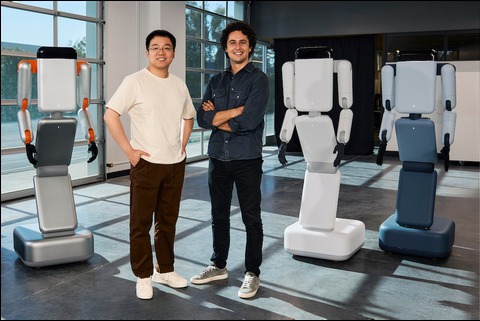
As for its hardware, Eno, the flagship humanoid, looks more like an iMac on wheels than a metal skeleton. So far, Genesis has built 30 to 40 Enos. Looking ahead, a mass-manufacturing contractor will start U.S. production next year, while the mass-produced design is already final. Meanwhile, a handful of undisclosed customers are piloting the robot.
Despite this progress, hardware remains the biggest hurdle. The dexterous hands last only a few weeks of regular work before needing replacement. Against this backdrop, the fresh Genesis AI funding gives Xian’s team more room to tackle that bottleneck. Even so, Xian remains confident. He says the company needs execution, not another scientific leap.