Google SynthID Detector Now Available Globally to Everyone to Expose AI Fakes
Quick Reads
- Google has opened its SynthID Detector to the public
- The tool can tell you whether a file was made with AI from Google or its partners, which include OpenAI, NVIDIA, Kakao and, soon, Apple.
- Google names OpenAI, NVIDIA and Kakao as partners whose AI content the detector can identify, with Apple to follow.
Google names OpenAI, NVIDIA and Kakao as partners whose AI content the detector can identify, with Apple to follow. The portal first launched in 2025, and after testing with journalists and media professionals, Google has now expanded access to everyone.
The tool can tell you whether a file was made with AI from Google or its partners, which include OpenAI, NVIDIA, Kakao and, soon, Apple.
What is SynthID?
SynthID is Google’s watermarking tool built for AI-generated content, designed to help people identify content that AI generated or altered. Google DeepMind introduced it in 2023. Google says it has now watermarked over 180 billion images and videos, plus 240,000 years of audio.
How SynthID works
The watermarks are embedded directly into AI-generated images, audio, text and video. Humans can’t perceive them, but SynthID’s technology can detect them. How it works depends on the content type.
Images and video: The invisible watermark is added the moment the content is created and does not reduce quality. It is designed to survive cropping, filters, frame-rate changes and lossy compression.
Audio: The watermark is embedded in audio from Google’s Lyria music model and the podcast feature of NotebookLM. It is inaudible and designed to survive added noise, MP3 compression and speed changes.
Text: For Gemini-generated text, SynthID subtly adjusts the probability scores of the words the model picks, which creates a watermark pattern without affecting output quality.
How to use the SynthID Detector
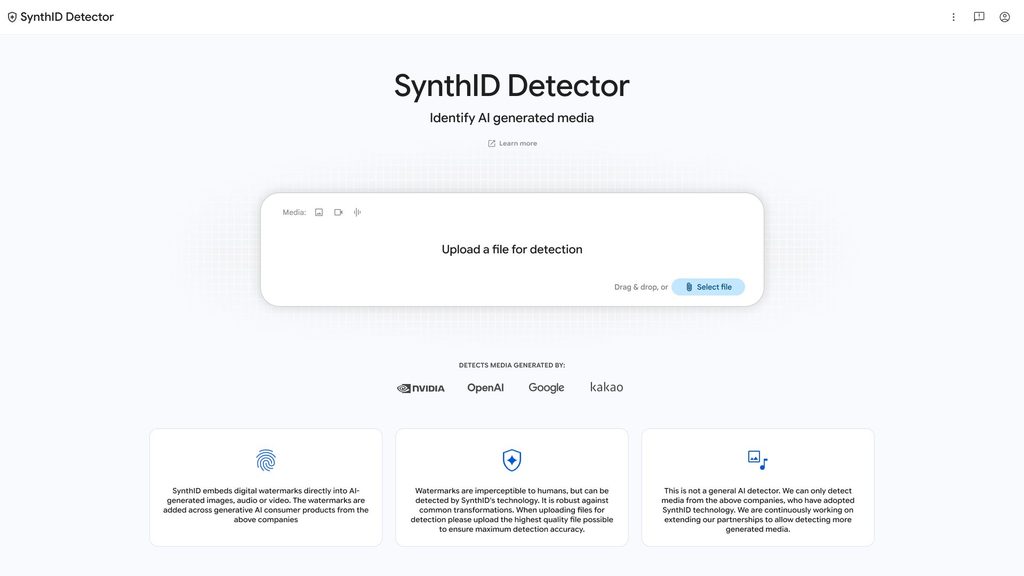
Go to synthid.com and upload the file. Reports say supported uploads include JPG, PNG, HEIC and GIF images, MP4, MOV and WEBM video, and MP3, WAV and FLAC audio. For video, the results appear on a timeline with the video and audio tracks shown separately. Google recommends uploading the highest-quality file you have to improve reliability.
Also built into Gemini, Search and Chrome
You don’t have to visit the website. Upload an image, video or audio clip in Gemini, Search or Chrome and ask whether Google AI created or altered it, and the tool will check for a SynthID watermark. These built-in checks now handle over 1 million requests a day.
The partnerships
OpenAI, NVIDIA and Kakao are already on board, and Apple is next. Reports say Apple plans to bring SynthID into image tools in iOS 27. The goal is one shared watermark standard that a single tool can check, instead of each AI company running its own detector.
What it can’t do
SynthID cannot flag content from AI systems that never adopted it. That means an image made with a tool like Claude would not be detected. A “no watermark found” result therefore does not prove the content is real.
Why it matters
There are limits. The detector currently works in English, and it only recognises content from partners that use SynthID. AI-generated media from other tools, including open-source models, can pass through undetected. African tech teams and journalists should treat it as one step in verification, alongside source checks, reverse image search and human judgment.