Simantic Bot Launches To Catch Firmware Bugs In GitHub PRs
Quick Reads:
- Simantic launched Simantic Bot, an AI reviewer for firmware that runs code in simulation inside GitHub pull requests instead of only reading it.
- Simantic says standard AI code reviewers miss firmware bugs in interrupt routines, peripheral timing and runtime memory.
- The company is a Y Combinator Fall 2026 startup from Waterloo, founded by Seungmin Hong and Ahnaf Shahriar, with about $600,000 raised.
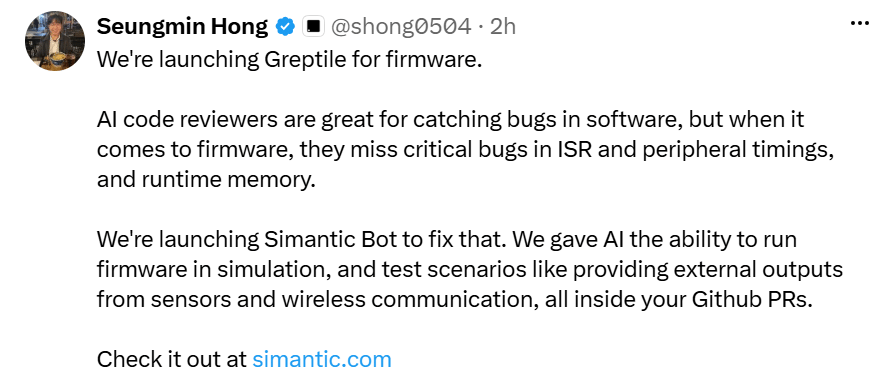
Simantic Bot is a new AI reviewer built for firmware, the low-level code that runs inside devices like cars, robots, sensors and consumer electronics. Its maker, Simantic, announced it on X with a pitch that was easy to follow: “Greptile for firmware.”
The comparison points to AI code-review tools that scan pull requests for bugs. Simantic’s argument is that those tools work well for ordinary software but fall short on firmware, because the hardest bugs only show up when the code runs against real hardware behaviour.
What Simantic Bot Does
According to Simantic, general AI code reviewers miss critical bugs in three areas:
Interrupt service routines (ISRs): short pieces of code that run when hardware signals the chip, such as a button press or incoming data. Small timing mistakes here can cause crashes that are hard to reproduce.
Peripheral timings: how code talks to sensors, communication chips and other attached components.
Runtime memory: problems that only appear while the program is running, such as overflows or corrupted data.
To catch these, Simantic gave its AI the ability to run firmware in simulation. The bot can also test scenarios such as feeding in external sensor outputs and wireless communication, all inside GitHub pull requests. A developer opens a PR, the bot runs the firmware against a simulated chip, and the findings come back where the team already reviews code.
The Technology Behind It
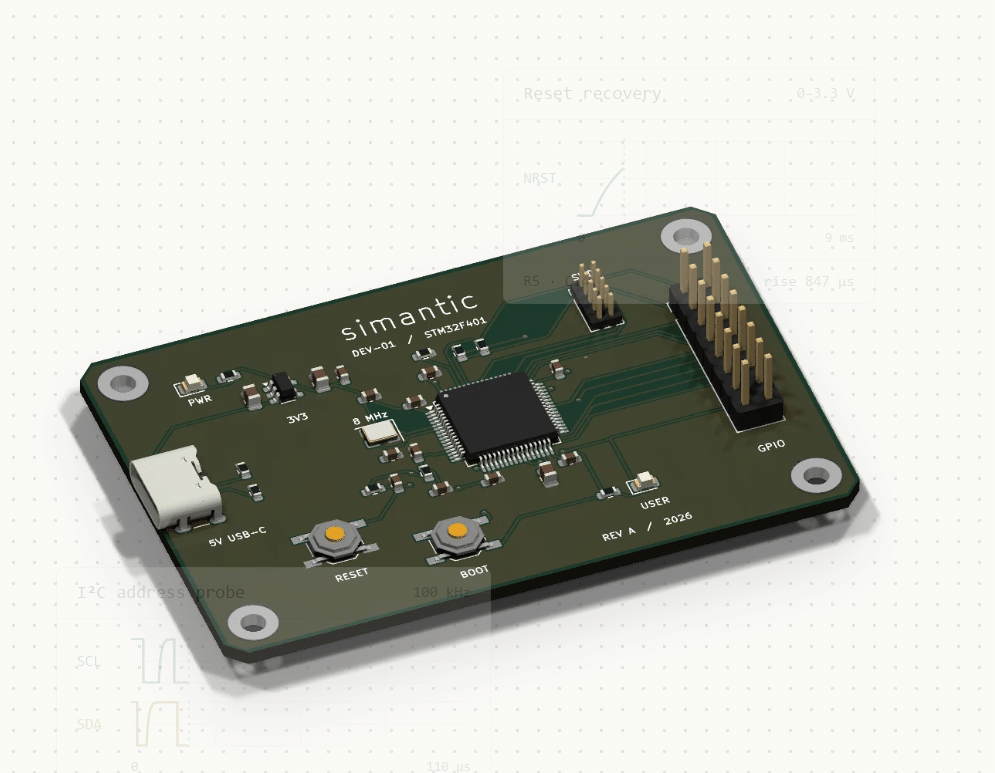
Simantic’s platform runs real firmware against emulated microcontrollers and peripherals, so a board can be validated before it is manufactured. Its site lists chip families including STM32, ESP32 and nRF.
The company also publishes a Python package, installed with pip install simantic. From public documentation, developers can load a compiled firmware file, run it on a named chip, and read variables, registers and RTOS threads while it runs, without halting it.
It plugs into pytest, so firmware tests can run alongside normal tests. Where a chip model doesn’t support a feature such as CAN or radio injection, the tool raises an error naming the gap rather than failing silently. Simantic says it doesn’t send file paths, project names, firmware or simulation output in its usage reporting.
The Company Behind It
Simantic was founded in September 2025 by Seungmin Hong, now CEO, while he was a computer engineering student at the University of Waterloo.
Ahnaf Shahriar joined as co-founder and CTO in early 2026. The name combines “simulation” and “semantic.” The team is four people, based in Waterloo, Ontario.
Hong previously worked as a firmware engineer at Tesla, Simbe Robotics and Rapyuta Robotics. The idea grew from the founders’ co-op terms at companies including Tesla and Neuralink, where engineers waited weeks or months for physical hardware before they could fully test firmware.
The startup has raised roughly $600,000, joined the Velocity incubator, and is part of Y Combinator’s Fall 2026 batch. It has also announced partnerships with Embedder, for agentic firmware development, and BoardRepo, for PCB design workflows.
Why It Matters
AI tools can now write firmware, but testing it still depends on physical boards. “Testing remains largely manual and dependent on physical devices,” Hong told the University of Waterloo.
If simulation can catch ISR and timing bugs before a board exists, teams could review firmware changes as quickly as they review software. Whether the bot’s findings match real-hardware behaviour is the question engineers will want answered.