Hugging Face Launches Carbon-X: Open-Source AI Model That Reads DNA and Text
Quick Reads
- Hugging Face’s Carbon-X, a 14B open-source model, lets researchers ask about DNA sequences and mutations in everyday language, and can also generate new DNA.
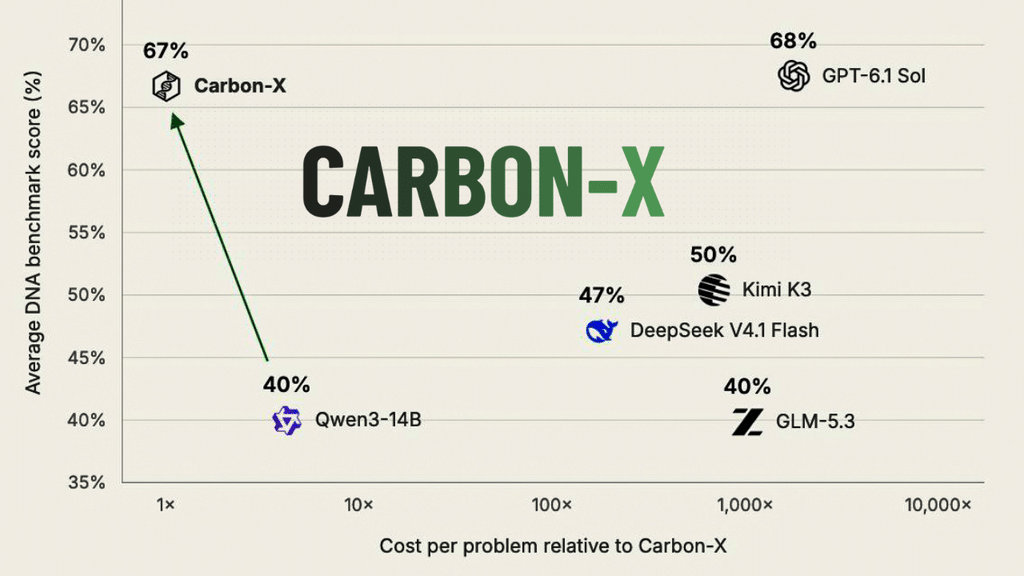
- The team says it beats every open language model it tested on DNA benchmarks and comes close to GPT-6.1 Sol at over 1,000 times lower inference cost.
- It runs locally on a laptop via llama.cpp under Apache 2.0, so DNA data stays on the user’s device. It is a research tool, not cleared for clinical use.
A new open-source AI model aims to bring genetic code and everyday language into one system. Carbon-X, a 14-billion-parameter model, was announced as the first to combine DNA and natural language at this scale. It can run locally on a laptop, and its developers say it competes with far larger commercial systems.
What Is Carbon-X?
Carbon-X is a language model trained to work with both DNA sequences and plain text. Most AI models handle one or the other. Carbon-X reads a genetic sequence and can also explain, discuss and reason about it in English.
It builds on the Carbon family of DNA models from Hugging Face. Earlier Carbon models were collaborative work between Hugging Face, Zhongguancun Academy and TIGEM at the University of Naples “Federico II”. The first release was a 3B model, which the team presented as open code, open weights and open data.
Key Features of Carbon-X
Strong benchmark results. The developers say Carbon-X beats every open language model they tested on DNA benchmarks. They add that it comes within about a point of GPT-6.1 Sol while costing more than 1,000 times less to run.
A new training approach. The model was mid-trained on 300 billion tokens of interleaved DNA and text. Supervised fine-tuning (SFT) followed, without distillation, and then reinforcement learning (RL).
A more efficient tokenizer. Carbon-X uses a hybrid tokenizer that encodes DNA with roughly three times fewer tokens than standard byte-pair encoding (BPE). Fewer tokens mean faster processing and lower cost. Earlier Carbon models paired a 6-mer tokenizer for DNA with a Qwen3 BPE tokenizer for English text.
A DNA specialist for other AI models. Carbon-X can act as a subagent that other models consult for genetic questions. The team reports that Kimi K3 gains 11.1 points on DNA tasks when it consults Carbon-X.
Local and private. The model runs on a laptop through llama.cpp and is released under the Apache 2.0 license. DNA data stays on the user’s own hardware, which matters because genetic information is among the most sensitive personal data there is.
Why It Matters
DNA models have mostly been research tools that need specialist knowledge and expensive hardware. The Carbon family has already stressed speed, with earlier models reporting throughput far above rivals such as Evo2-7B. Carbon-X adds a language interface on top of that, so researchers can ask questions in plain English rather than write specialised code.
Running locally also changes who can use it. Students, small labs and independent researchers can work with a capable DNA model without paying for large cloud systems or uploading sensitive sequences.
What to Watch
The benchmark claims come from the developers and will need independent testing. Comparisons to commercial models also depend on which benchmarks were chosen. Researchers should check the model card and published blog post for evaluation details before relying on the results.
Availability
Carbon-X is open source under the Apache 2.0 license, with model weights and a technical blog on Hugging Face. Add the direct links before publishing