Consumer AI Spending Takes a Surprising New Turn
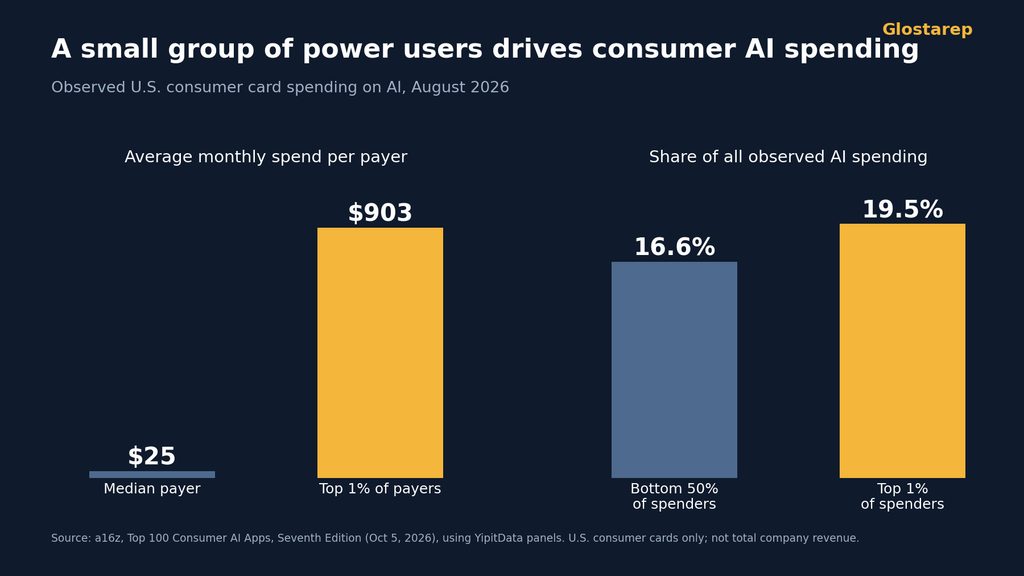
Consumer AI usage is wide, but not very deep. Nearly half of U.S. consumers now report using AI. However, consumer AI spending remains concentrated among a much smaller group of paying users. Only 4.5% pay for a leading chatbot subscription. Meanwhile, a small group of power users drives a large share of overall spending.
The top 1% of AI payers spend an average of $903 a month on consumer cards.
Why Most Consumers Still Don’t Pay for AI
- U.S. consumers who report using AI: nearly half
- U.S. consumers who use AI daily: 25%
- Eligible U.S. consumers with a paid ChatGPT, Gemini, or Claude plan, August 2026: 4.5%, up from 2.1% a year earlier
- Users who pay for one AI product and also pay for another: 13%
SOURCE: a16z, Top 100 Consumer AI Apps, Seventh Edition
The Power Users Driving Consumer AI Spending
While most consumers are still reluctant to pay for AI, consumer AI spending is increasingly concentrated among power users. The top 1% of payers alone account for nearly one-fifth of observed spending.
- Average monthly spend of the top 1% of payers, August 2026: $903, up 80% in 18 months
- Top 1% share of all observed consumer AI spending: 19.5%
- Bottom 50% of spenders combined: 16.6%
- Median monthly spend per payer: $25
- Top 10% of spenders: roughly half of all observed spending
SOURCE: a16z, Top 100 Consumer AI Apps, Seventh Edition
Leading Platforms, by the Numbers
This concentration is also reflected in where consumer AI spending goes. A relatively small group of platforms accounts for much of the observed spending, with ChatGPT maintaining a substantial lead among U.S. paid subscribers.
- ChatGPT: 3x more U.S. consumer paid subscribers than Claude or Gemini
- ChatGPT’s mobile monthly active user lead: 2.5x over Gemini, 14x over Claude
- Payers on the $100-a-month tier: 7.3% of Claude’s, 1.3% of Google’s, 1.1% of ChatGPT’s
- Top 10 by observed spending: OpenAI, Anthropic, Canva, Superhuman, Higgsfield, Replit, Suno, Lovable, Perplexity, ElevenLabs
- Top 50 spending vendors missing from web and mobile traffic lists: 29
SOURCE: a16z, The Top 100 Gen AI Consumer Apps, 7th Edition
How AI Products Make Money
At the same time, AI companies are using several monetization models to turn consumer demand into revenue.
- AI-native products in the web ranking with a live monetization model: all 44
- Products offering paid subscriptions: 84%
- Products offering usage charges or extra credits: 64%
- Products running ads: 14%
- Products earning transaction or platform fees: 2%
- ChatGPT advertising run rate, August 2026: $1 billion annualized, per OpenAI, on 1.2 billion weekly active users
SOURCE: a16z, Top 100 Consumer AI Apps, Seventh Edition
Data note: The spending figures cover U.S. consumer cards only. They come from YipitData panels, so they do not show total company revenue.
Overall, consumer AI has found its first real market in people who build, create, and work with it. As a result, consumer AI spending is being driven disproportionately by users who see enough value to pay for multiple or premium AI products.
For these users, subscriptions fit well. However, most consumers still will not pay, so ads and transaction fees may decide the next phase. Ultimately, the way AI companies monetize their products could determine how widely these tools are accessible. If AI stays locked behind a paywall, who gets left out?